MODULE 7:
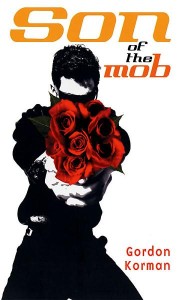
SON OF THE MOB by Gordon Korman
Korman, G. (2002). Son of the Mob. New York, Hyperion.
Son of the Mob takes a curious mix of reality and comedy. It presents a plausible real-life scenario that young adults can relate to while at the same time picks an extreme example of family life interfering with private life. Son of the Mob is an amusing, well-paced story that is a little bit Romeo & Juliet, a little bit Clueless, and a little bit Goodfellas.
Vince Luca is in many ways like all seventeen-year-olds. He has no social life apart from his whiny sex-obsessed friend Alex Tarkanian. Vince longs to have a regular life, where he has a girl, pays his own way, can get to university (and far from his family) and passes his classes.
Vince however, is not like other guys, and especially not like the rest of his family. He is the only one of them who isn't in what Vince constantly refers to as 'the vending-machine business', which is run by his father, Anthony "Honest Abe" Luca. Dad earns this nickname because he can be trusted to be square in all his business deals, even if the 'vending-machine business' is really a more dangerous one. Vince is the only member of his family not involved in "The Life", which is a euphemism for The Mob.
That's right: Vince Luca is a Mob Prince, but unlike his cooking-happy mother or hot-tempered brother Tommy, Vince wants no part of the business. He's a civilian and has made clear he intends to stay that way. Vince is pretty much kept clear of things, and that includes getting some perks (he insists on paying for a Mazda with a cracked sunroof rather than take a more luxurious car, given the last time he did, he was pulled over for driving a hot Porsche). However, he also realizes that all his food, clothes, and pocket money are provided through these means.
Vince is desperate to keep his family and his private life separate, but despite his best efforts things keep colliding, like when his one date with Angela O'Bannon is wrecked by finding Jimmy Rat stuffed in his Mazda. Oddly, that freaks Angela out and it kind of kills the mood; this is courtesy of Tommy, who used Vince's car and forgot about it (and that's despite Anthony Luca putting a trusted aide, Ray Francione, as unofficial guardian). Vince likes his Uncle Ray, the only one of his various Uncles who doesn't think it strange that Vince wants no part of The Life.
To make up for this debacle Tommy arranges for a date with Cece, a very beautiful woman Vince at first mistakes for Tommy's new girlfriend. Well, she can be both Tommy and Vince's girl...for a few hours. She's really a hooker Tommy hired to take Vince's virginity, and while Vince is intensely attracted, he's also horrified. Later on, pushed by Alex, they go to a college party where Vince reencounters another classmate, Kendra Bightly, and to get rid of a guy Kendra kisses Vince. Soon, they find an attraction (and head lice) that brings them together and begin dating.
 Vince keeps this secret from the Family, and especially after he finds out that Kendra is the daughter of FBI Agent Bightly (whom Anthony calls Agent Bite-Me), who has bugged the Luca home. Here Vince is, finding a girl he really, really likes and who likes him, and it has to be the Agent's daughter! Complicating matters is Jimmy Rat and another low-level thug, Ed Mishkin, both of whom owe debts to the Lucas. Of course, this means they are going to get whacked (or in Ed's case, he's going to whack some old aunt for the inheritance). Vince doesn't want them dead (he has too many memories of other Uncles going to the house to get bullets removed or fingers cut off), so he agrees, just this once, to step in and try to get their financial houses in order. Dad isn't too keen on this, but figures this is a good way to get his somewhat lackadaisical son motivated in something.
Unfortunately, Vince's well-meaning involvement causes him unexpected trouble. It also doesn't help that his New Media class project, designing a web page where your grade is based on number of hits, also finds its way into The Life. Something as innocuous as iluvmycat.usa becomes a big online hit thanks to the Meow Marketplace, a section of Vince's website where you can put cats for sale. However, Vince is puzzled by the odd ads appearing, such as:
I'm selling my third-favorite cat, Lady Anne. She's a real winner, pure gold. $200.
If you're looking for a prime minister of a cat, you've come to the right place. Dynamico caught three mice last week. Only $100.
I'm selling exactly two of my cats, Kensington and Scattered Showers. You've never seen such a couple of movie stars. They're number one! $200 for the pair.
The last two really confuse Vince. Who refers to their cat as 'prime minister'? How are two cats both "number one"? It takes a long time for Vince to make the connection between Meow Marketplace and Tommy's sudden interest in the Internet. On the Jimmy/Ed front, Vince finds that they are getting played, and that Honest Abe Luca is in on it. This leads to a major falling out between them, a falling out that is healed after Vince finds who the mole in the family is. This revelation is preceded by Vince's discovery that Mama Luca is more Livia Soprano than Carmela Corleone. In the end though, Kendra and Vince are reunited (she broke up with Vince after thinking he was in The Life too as a loan shark), Jimmy and Ed manage to make enough to pay off everyone thanks to misinterpreting Vince's words about a major rainstorm, Vince and Alex remain friends, and Vince himself stays out of The Life...but won't get the Luca and Bightly families over for any cookouts anytime soon.

The Mafia has an odd hold over the American imagination. It certainly does over my best friend/brother Gabe, who is passionate about all things gangster. From The Godfather and Goodfellas to The Sopranos and even Mob Wives, La Cosa Nostra has been something that Americans have glamorized and mystified. Son of the Mob is a more lighthearted take on it, with a unique vantage point of that of the clean son (think Michael Corleone before he went all evil). Vince is not blind to the Luca 'vending machine business', but he also wants his life to be different.
This isn't to say Vince is particularly noble or upright. In many ways, he's his father's son: able to give what he calls The Luca Stare to try to push others to do what he thinks needs to be done. He also describes himself as being like the other men in his life: unable to speak on emotions, with grunts and sleeveless t-shirts being the extent of his 'feminine side'.
However, he also wants to be different from his family. He wants a life separate from The Life and dislikes it whenever he finds that The Family gets in the way of his own life. We see this right at the beginning, where his date is ruined by having a low-level thug stuffed in the trunk. We also see from this opening that Son of the Mob is meant to be light (if it were dark, Jimmy Rat would be dead, but here, he's just been roughed up a bit). This dark humor does lighten up in unexpected ways. Jimmy and Ed torch their places to collect insurance money, thinking this was all Vince's idea. He told them that a major storm was heading, and they mistook this for him suggesting they take advantage of the storm to make it look like the lightning had caused fires to break out. What Vince was really saying was that...there was a major rainstorm coming.
While it is highly exaggerated, Son of the Mob is a book I think kids will relate to in a roundabout way because at one point or another, every child wants to both be separate from his family to form his/her own identity and find that their parent's jobs do get in the way. What parent hasn't at one point or another embarrassed their child, or not been able to be there because of business?

The characters are also relatable. Vince in particular is a fine example of the first-person narrative. He isn't eloquent but his voice is real in his acceptance of how his family is and in how he sees things. His horror at Cece 'hitting' on him, his worry about not passing the New Media class, his terror at possibly becoming Homecoming King: while deliberately overdone, Korman makes Vince into a genuinely likeable fellow.
Korman does the same for the other characters: the weasely Jimmy Rat, the surprisingly kind Ray, the frustrated best friend Alex. Even someone we don't hear much gets both a good twist and some laughs. On a date at a Mexican restaurant/karaoke bar, Vince is stunned to see Uncle Pampers, a big-time hit man. He's even more stunned to see this big-time assassin casually walking up to the microphone and belt out some Hank Williams, Sr. (and more stunning, being very good at it, right down to the yodeling). This is where Son of the Mob really excels: the mixing of character and situation, playing with our conventions about mobsters.
Who knew a guy who whacks people for a living would be passionate about country music and karaoke?
Korman has a well-crafted and tight story for the most part, injecting humor in the best places. When the mole plays a tape of Mother Luca about to order a hit, it then gets interrupted by Kendra's voice singing If I Had a Hammer. This ties in to what we learned earlier about Kendra: that her father no longer brought his work home after 'some evidence was accidentally destroyed' and that she had a habit of recording her own karaoke whenever the mood struck her in various tapes with little actual organization.
There's something cinematic about Son of the Mob, where these sort of things could be seen in a movie (the major blowup between Anthony and Vince in the middle of the huge rainstorm is another).
If I were to say anything negative about Son of the Mob, is that I figured out Meow Marketplace was being used as a front for gambling long before Vince did. Knowing his family like he does, and Tommy in particular, I wonder what took him so long.
Son of the Mob was a fast, delightful read. The situations may be dangerous, but are handled in a comical way. The plot holds up extremely well and young readers especially will like the mix of the familiar with the outlandish. Vince comes across as a genuine guy with problems young adults know (getting and keeping a girl) and don't (keeping two low-level thugs from getting whacked). It proved so popular that Korman wrote a sequel: Son of the Mob: Hollywood Hustle. On the whole, Son of the Mob is a book young adults and mob aficionados will enjoy for its humor, mix of good characters, situations, and logic.
BRIEF REVIEW DISCUSSION
The Kirkus Review for Son of the Mob agrees with me on how well the humor is handled in the book. "Maintaining the balance between situational humor and the real violence and ugliness of organized crime is no easy matter, but Korman pulls it off in fine manner, managing to create genuinely sympathetic characters in Vince’s family—people who love him and want the best for him, but who can at the same time call out a hit on someone as casually as ordering a pizza." Korman does balance the genuine heart of the romance between Vince and Kendra with the humor of the 'vending-machine business' and all the trouble it causes the only civilian in the Luca family. There is a lot of humor in the story, but also a genuine heart for these 'star-crossed lovers' reenacting their own Romeo & Juliet (I do so love Shakespeare).
PROGRAMMING SUGGESTIONS
There are a couple of programs one could try. A major point of Son of the Mob is that the Luca Family is in 'the vending-machine business'. Why not offer a vending machine contest (or exhibit, because I wonder if kids still play vending machines)? One might open a virtual or real 'Meow Marketplace', and I'd offer have a cat race (if cats do race, which I doubt). Kendra and Uncle Pampers love to karaoke, so there's another opportunity to have a karaoke contest. However, unlike the book, no food-throwing at the singers will be permitted.
 |
| Gordon Korman Born 1963 |
REFERENCES:
Book Review: Son of the Mob by Gordon Korman (2010, May). Kirkus Reviews. Retrieved from https://www.kirkusreviews.com/book-reviews/gordon-korman/son-of-the-mob/