Showing posts with label Module 2. Show all posts

Tuesday, February 10, 2015

Module 2--The Westing Game: A Review


MODULE 2:
THE WESTING GAME
 by Ellen Raskin

Raskin, E. (1978).  The Westing Game.  E.P. Dutton: New York

The Westing Game is a child-centric mystery which has touches of And Then There Were None and The Casual Vacancy (though the latter was written long after The Westing Game) while I found it sometimes a dull read I also found that at times it was actually a bit clever.

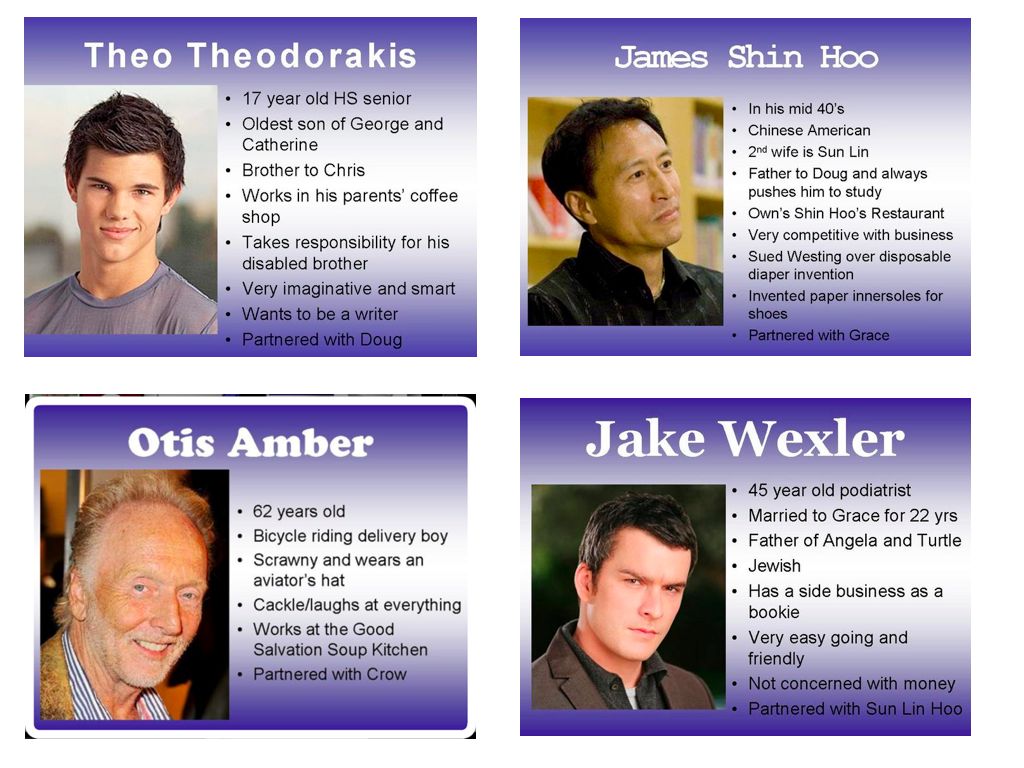
Sixteen different people, some as families, some as singles, are brought together to live at Sunset Towers, a new high-rise apartment complex facing Lake Michigan and the home of Sam Westing, a fabulously wealthy but reclusive individual.  The various families live and sometimes work at Sunset.  There are the Hoos: son Doug, a track star, is a bit of a disappointment to his father James, who would rather his son help him and his new (and younger) Chinese wife at their restaurant on the top floor.  James also dislikes the competition he's getting from the coffee shop at the ground floor, run by the Theodorakis family: Theo, an aspiring writer, his disabled brother Chris, and their father George. 

Also in the apartment is the Wexler family: podiatrist Jake (also a bookie), his uppity wife Grace, and their two daughters: the beautiful Angela and the miscreant Turtle (Tabitha-Ruth), who is passionate about the stock market despite being 13.  We also have seamstress Flora Baumbach, judge J.J. Ford, cleaning lady Berthe Erica Crow, doorman Sandy McSoutherns, delivery boy Otis Amber (boy being a misnomer given he's in his sixties) and Sydell Pulaski, a secretary who craves attention but was inserted into the Westing game by mistake.  Sydell was mistaken for a Sybil Pulaski when the group was brought together.

At first, the neighbors rarely interact, until they are named heirs to the Westing fortune.  However, Samuel Westing in his will tells them that he was really murdered...by one of them!  Further, in order to get the money they will be paired off, given a set number of clues, and then attempt from those clues to solve Westing's 'murder'.  We get them becoming suspicious of each other, there are few bombs that go off that except for Angela cause no real harm, and we find that the characters are in one way or another connected to the Westing family.  In the end, only Turtle really finds out the truth about Westing, but keeps her promise to remain silent.  We learn the fates of everyone involved in the Westing game in the end.


I don't know why The Westing Game is so beloved by people.  I remember back in middle school a lot of my friends/classmates read or knew about The Westing Game.  I didn't read it back then, and perhaps I would have enjoyed it if I had since back then, I was crazy about Agatha Christie.  However, reading it now I find it parts idiotic, parts mean-spirited.  The clues as I read them were clearly connected to the song America the Beautiful, but I kept wondering why none of the other characters until late in the game managed to think that.  Now, it might be that Raskin wanted the reader to know all that.  It is also true that the reader had all the clues while the characters just had a few.  However, even when I read just one or two of the groups America the Beautiful was the first thing to pop to mind, which made one of the character's names (Otis Amber) a really easy clue to figure out. 

I said it had similarities, to me at least, to J.K. Rowling's The Casual Vacancy, and that has to do with the fact that I found pretty much everyone in the book unlikable.  Turtle I figure was suppose to be humorous in that she would kick anyone in the shins if they pulled her braids, but in the book, but I found her more annoying than endearing.  Granted, she did cover up for the real bomber, but I wasn't too thrilled with the idea of bombing in general (as benign as they might be).  Her mother Grace was the worst: virtually ignoring Turtle for the sake of Angela (who was pushed into marriage to the intern Dr. Deere, a real doctor, not like her unfortunately podiatrist husband), she was in many ways quite bigoted.  She wasn't too thrilled with the idea that her husband was Jewish, and made assumptions about Asians.  Crowe's religious fanaticism also didn't sit well with me, as if it were somehow mocking Christians as these wild-eyed loons.  Chris Theodorakis, who is disabled, is a result of an accident that left him both incapable of controlling his body and with a speech impediment.  That struck me as close to ridiculing the disabled.  Yes, he was really bright and in the end he got something of a cure (he never walked again but the spasms and speech were kept in control), but I still wasn't fond of it.

Raskin also used some now-unacceptable terms when describing people.  Flora's daughter died prior to the events of The Westing Game, and the child is referred to as a "Mongoloid", which for people with Down's Syndrome I think is a slur. 
I had some questions about the plot as well.  Why go through all these bombings which if memory serves correct weren't connected or thinly connected to the mystery?  In the will, we get stage directions written into it (at one point, the lawyer reads from the text of the will, "Sit down Grace Wexler", but I think it's a little TOO convenient to know Grace would stand up in shock).

I did find the bit about 'directions' to be clever and something I wasn't expecting.   I also liked the fact that just about everyone, even the variations of Westing, got a happy ending of sorts.  I also as I noted said it reminded me of And Then There Were None in how all the characters are connected in a roundabout way. 

However, on the whole I was surprised at the violence within it (all those bombs, one which left Angela scarred for life), I thought the plot didn't hold well together.  I didn't care who won the Westing Game and felt it buildup and praise for it is extremely exaggerated.

BRIEF REVIEW DISCUSSION

I find that in the last point, I am in the minority.  Elizabeth Bird, a New York City Public Library Youth Materials Collection Specialist, praised it as an ode to capitalism.  Roberto De Leon, a public library teacher, noted like I did the similarity to a Christie novel ("an elaborate homage to her favorite author Agatha Christie", he called it), and went on to call The Westing Game a masterpiece.  I wouldn't go that far.  I think younger readers might enjoy it, but for myself, I found no pleasure in The Westing Game and find it a terrible disappointment.   I do, however, see how it is similar to an Agatha Christie novel: a variety of suspects, many with secrets but not strictly connected to the crime, and gathering them to solve the crime.

PROGRAMMING SUGGESTIONS

As for any use in the library, perhaps a display for mystery novels would work.  I could offer also a scavenger hunt for clues, complete with a shadowy figure giving clues for prizes, or even a singing of America the Beautiful as it was a major plot point. 


Ellen Raskin
1928-1984


REFERENCES:

Bird, E. (2012).  Top 100 Children's Novels #9: The Westing Game by Ellen Raskin.  A Fuse 8 Production. 

http://blogs.slj.com/afuse8production/2012/06/17/top-100-childrens-novels-9-the-westing-game-by-ellen-raskin/#_

De Leon, R. (2013).  A Nerdy Retro Review of Ellen Raskin's The Westing Game.  Nerdy Book Club. 

https://nerdybookclub.wordpress.com/2013/11/19/a-nerdy-retro-review-of-ellen-raskins-the-westing-game-by-roberto-de-leon/

Monday, February 2, 2015

Module 2--Strega Nona: A Review


MODULE 2:
STREGA NONA: Written and Illustrated by Tomie dePaola

DePaola, T. (1975). Strega Nona. New York: Simon & Schuster Books for Young Readers.

Strega Nona is billed as 'an original tale', probably because it is told and reads as if it were an old Italian fable. 

In Calabria, everyone goes to Strega Nona (or Grandma Witch) to cure what ails them.  Even the priests and nuns from the convent go to her, and she can fix anything from warts to love potions.  However, she's getting on in years, so she goes to the town square to put up a Help Wanted ad.  Answering it is Big Anthony, who doesn't pay attention.  He is a good worker, but one day he spies Strega Nona using her magic pasta pot, which cooks by itself at her command and stops at her command.  Unfortunately for him, he didn't see Strega Nona blow three kisses that complete the part of the spell where she stops the pasta cooking.

Big Anthony goes to town, tells everyone about the pot (despite being told not to use the pot) and cooks for the whole town.  He can't stop it though because he doesn't blow the kisses.  Soon the town is coming under attack by pasta.  Fortunately, Strega Nona arrives from her journey to see all this and blows the three kisses to stop the pasta.  The town is grateful to Strega Nona for saving them, but she has a problem.  There is all this extra pasta and her house is completely drowned in it.  She wants to sleep in her own bed tonight, so there's only one thing for it: Big Anthony has to eat ALL THE PASTA.


Strega Nona, after reading it, reminded me a bit of The Sorcerer's Apprentice sequence from Fantasia.   In both tales we have essentially a servant who uses magic that he has seen his master/mistress use; it starts out well, then gets out of control. The servant can't stop it and then the master/mistress sees things in total chaos.  The wizard/witch saves the day, and the servant is punished...mildly.  "The punishment must fit the crime," Strega Nona tells the town that wants to hang up Big Anthony for putting them all in danger of death by pasta (what a way to go). 

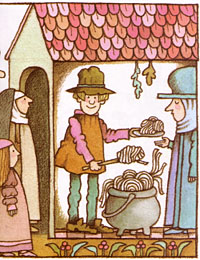
Above all else, I think dePaola's illustrations are immensely beautiful.  They are simple and simultaneously elaborate.  You can see the richness of the drawings by the way dePaola has the characters dress.  Interestingly, dePaola tends to have most if not all his characters see in profile and in formation, as if they were one group facing one direction.  He does illustrate characters to face us, but on the whole this is rare. 

The illustrations also help emphasize the story.  In the opening, we are told that the town talks about Strega Nona, but they still go to her, even the religious who might be told to stay away from a witch.  The drawings show people whispering on the upper part of the illustration, but the lower part shows that the group of people are there, including the priest and nuns from the convent.


This is a great way to show early readers how words tie in to actions and how the drawings match what is written down. 

The story itself is quite simple and direct: don't mess about with things you don't understand.  Strega Nona had made it very clear that Big Anthony was not to touch the pot, but he did so anyway.  I think Strega Nona shows that Big Anthony wasn't bad.  It does say more than once that his flaw was that 'he didn't pay attention'.  Also, he used the pot to show that he wasn't a liar since the town laughed at him for making such a ridiculous claim that a pot could cook itself.  In short, he wasn't a bad figure, and the ending shows that he got his just desserts (no pun intended).

There are only two real characters: Strega Nona and Big Anthony.  Everyone else is a mere townsperson save the Mayor, who is angry at Big Anthony for the chaos he created.  However, Strega Nona is more about Big Anthony, as he is the one who sets everything into motion.  We really see the story from his perspective.  Strega Nona is the starting point, but the story isn't about her.  It really is about Big Anthony trying to show he can do something he shouldn't (and something he can't control).  Strega Nona herself is just the catalyst for the situation.  You could have created any story around Strega Nona (the man who was cured of his warts, the girl who found a husband, the lady cured of her headache), but alone Strega Nona in Strega Nona needed someone to act opposite.  Therefore, I'd say the story is about Big Anthony and not Strega Nona herself. 

Strega Nona is a very sweet little tale, though perhaps a bit text-heavy for really early readers to tackle.  It is best to read this to children barely learning to read, as the illustrations will help children understand the concepts of the text.  Children will enjoy the beautiful drawings and the positive story of being true to your word.  It has humor, sweetness, and again simply beautiful illustrations.

BRIEF REVIEW DISCUSSION

The concept of Strega Nona mirroring The Sorcerer's Apprentice is noted by Field Norma Malina's review, who called the story a 'variation' on Sorcerer's Apprentice.  Malina also noted that the illustrations, with their 'muted colors', captured a Mediterranean style.  I think both statements are entirely accurate, and I also think dePaola had that in mind.  He wanted to create a story that was simple, sweet, with a good moral.  He's also talked about how Disney films influenced him as a child, so I don't think it's surprising that The Sorcerer's Apprentice seeped its way into the story.  DePaola also was intelligent in working his illustrations to mirror the style of Italy, which lends it an air of authenticity, as if it really was an old legend rather than dePaola's original creation.

PROGRAMMING SUGGESTIONS   


The library would be best served to have a program where the public is invited to a big Italian dinner.  It would be a positive to invite any Italian or Italian-American groups to use Strega Nona as an entry for the community at large.  Strega Nona could also be used to create a costume contest as the characters of the series.  It might even be a way to introduce an Italian-language course or programs on Mediterranean cultures.    

Tomie dePaola:
Born 1934


REFERENCE:

Norma Malina, F. (2003). Review of Strega Nona. In S. Peacock (Ed.), Children's Literature Review (Vol. 81). Detroit: Gale. (Reprinted from New York Times Book Review, 1975, August, 8).
a2c811321fdc0b0782a7c44303a38f18