Showing posts with label Newberry Winners. Show all posts

Saturday, February 28, 2015

Module 4--A Wrinkle in Time: A Review


MODULE 4: A WRINKLE IN TIME by Madeleine L'Engle

L'Engle, M. (1962). A Wrinkle in Time.  New York, Square Fish: An Imprint of Macmillan.

A Wrinkle in Time has achieved both legendary status and controversy due to the same issue: the mystical/religious aspects of the book.  Some have found in A Wrinkle in Time too much religion, particularly Christianity, and some the opposite: too much occult/anti-Christian material in it.  I was pretty surprised at how open the book was in acknowledging the existence of God and Jesus in the world of fantasy.  This was neither a negative or selling point for me, as I found A Wrinkle in Time a good read, though a bit rushed for me.

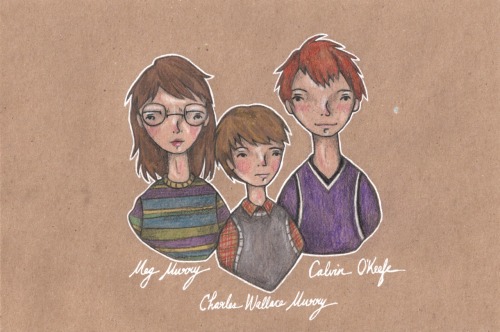
Meg Murry is a pretty typical fourteen-year-old girl.  She has braces and glasses, and is carrying a lot of anger within her.  Her father, a scientist, has disappeared and rumors are going around that he ran off, maybe with another woman.  Mrs. Murry, a scientist in her own right, tells Meg and her other children: twins Sandy and Dennys and Charles Wallace, a five-year-old genius whom the town thinks is an idiot, that Mr. Murry has not abandoned the family but he has disappeared due to his work.  Charles Wallace is visited by the first of three figures he met while going to a 'haunted house': a figure dresses in many scarves and coats who calls herself Mrs Whatsit.  Mrs Whatsit is also seen by Meg and Mrs. Murry, who tells the latter that 'tesseract' is real.  This shocks Mrs. Murry.

Charles Wallace and a very reluctant Meg go to Mrs Whatsit's home, where they find Calvin O'Keefe, a thin redheaded freckled-faced boy, slightly older than Meg, who is a star athlete but from a troubled home who like Meg feels out of place.  Calvin senses that he has been 'invited' to go to the house, and the three of them next meet the second mysterious figure, Mrs Who, who speaks in phrases of various languages.  They and Mrs Which, the third figure who can never fully materialize but who has enormous spectacles and who speaks by elongating every word, whisk the three children off to help rescue Mr. Murry.

Here, the three children go to various planets as they prepare to fight the dark force holding Mr. Murry prisoner.   The first planet is the beautiful Uriel, where they discover angelic voices singing excerpts from Psalm 96 (Sing unto the Lord a new song...) and get a glimpse into a Dark Being in a vision.  They visit The Happy Medium, a figure in turbans with a crystal ball who shows them Earth, a world half in darkness half in light that has been fighting the Dark Figure with such figures as Jesus, Bach, Gandhi, and Buddha among others.  They also learn that these beings, former stars, are able to travel quickly from one point in space to another thanks to tesseracting (or the ability to bend time to get from Point A to Point B through the fifth dimension).  This is what Mr. and Mrs. Murry had been working on, and which caused Mr. Murry's disappearance.

Now, with words of wisdom, the gift of Mrs Which's glasses, and warnings that they must all stay together, the children are sent to the planet Camazotz.   Here, everyone is literally the same: the children all act the same, the parents all act the same, there is total uniformity.  The children decide to go to the CENTRAL Central Intelligence Center.  Here, they discover the Man With the Red Eyes, an evil being who has the power to hypnotize everyone and bend them to his uniform will.  Charles Wallace's high intelligence makes him vulnerable to the power and he becomes enchanted. 

He is really working for IT, a powerful brain that controls the group-think of Camazotz.  Meg and Calvin do discover Mr. Murry, who is held prisoner there because he refuses to succumb to group-think; with the Man With the Red Eyes growing in power, Mr. Murry tesseracts the two of them to another world via Mrs Which's glasses. 

The trip nearly kills Meg, who is angry that her beloved father couldn't rescue Charles Wallace and left him on Camazotz.  On the new planet of Ixchel, Meg is nursed back to health by Aunt Beast, a seemingly frightening-looking creature with four arms and tentacles but who is really gentle.  The Three Ws reappear, and give Meg the task of rescuing Charles Wallace.  She has one thing IT does not have, and back on Camazotz the normally kind Charles Wallace is sarcastic towards his 'dear sister'.  Finally, Meg realizes what she has that IT doesn't have: love.  Her love breaks the spell on Charles Wallace, and they all escape back to Earth by being tesseracted by the Three Ws. Calvin and Meg have fallen in love, and it adds to the joy of the family reunion where the Murrys are brought together at last.


One thing that A Wrinkle in Time has as a positive is relatable characters.  Meg, Calvin, and Charles Wallace read as real kids. There's the angry and insecure Meg, constantly talking herself down.  There's Calvin, the outwardly outgoing star athlete who hides an unhappy homelife where he is basically ignored by his family and feels out-of-place himself.  Charles Wallace (he is almost always to by his first and middle name): the bright child-genius who accepts his gift with a certain nonchalance.  The relationship between Meg and Charles Wallace, and the one that grows between Meg and Calvin, are believable.

There is a great fantastical vision in A Wrinkle in Time.  You've got the funny Three Ws, who are all unique characters. They have their own characteristics that makes them easily identifiable.  There is the quest: the search for the father.  You have an overwhelming sense of danger and fear with The Man With the Red Eyes.

Where I think A Wrinkle in Time kind of went off for me was with IT.  The idea of a disembodied brain being the center of this dark world strikes me as almost funny.  Somehow, all the evil or totalitarian nature of Camazotz being brought on by a brain seemed a pretty odd figure.  Why not have The Man With the Red Eyes be the actual dark figure?

Also, after the rescue, Mr. Murry didn't seem to be that big a part of the story.  I think he is almost a plot device, a reason for the quest but who doesn't enter into the story itself.

These are really minor points because the description of Camazotz as this dark place where everyone is the same is frightening. The descriptions of the other worlds is also well-done.

I don't think A Wrinkle in Time is meant to be Christian allegory like C.S. Lewis' Chronicles of Narnia.  We do have quotes from the Old and New Testament (Aunt Beast quotes a version of Romans 8:28--"we are called according to His Purpose", and Mrs Who quotes a version of 1 Corinthians 1:27--"He uses the foolish things of the world to shame the wise").  There is the acknowledgement of evil and of Supreme Being (that being God in the Judeo-Christian tradition).  However, I don't read A Wrinkle in Time as symbolic of a Christian story (unlike Lewis' The Lion, The Witch, and The Wardrobe, which is symbolic of Christ's Death and Resurrection).  I don't think IT the brain is meant to represent Satan or Camazotz to be Hell.

Camazotz, however, could be something like Hell because the uniformity where everyone is exactly alike, all controlled by one being who decides all things for them and who punishes nonconformity, is a nightmare place.  Whether L'Engle meant to represent something like the Soviet Union or some other dictatorship I don't know.  However, it is open to interpretation.

BRIEF REVIEW DISCUSSION

A review for A Wrinkle in Time comments on how Meg's "refreshingly believable behavior resonated with" the reviewer, and I can see how that is possible.  The main characters are not perfect (they can be excessively self-assured or frightened and angry), but that's what makes them real.  I think young readers will appreciate that the characters were not perfect, in short, like them.   All the human characters are quite relatable, which works for the target audience.  The non-human characters are amusing or frightening when they have to be, and with some switches in perception (Aunt Beast being really kind despite her frightening looks) children will appreciate that judging by appearances is wrong.   I think that A Wrinkle in Time might make others want to read the other stories in the series.  I personally can take it or leave it, but wouldn't begrudge others who would like to learn more. 

PROGRAMMING SUGGESTIONS

I don't know what kind of program one could create for A Wrinkle in Time.  There might be a dress-up contest where children are invited to come as one of the Three Ws (Mrs Which would be the most creative since she never fully materializes) or Aunt Beast (which can lead to equally imaginative costumes).  We might sponsor a quiz-type contest to find the next Charles Wallace, and if one wanted to really frighten children, put in some Men With Red Eyes around the library for children to discover, maybe even have a staff member pop up with red eyes.  Hopefully though, they will find older children to scare. 
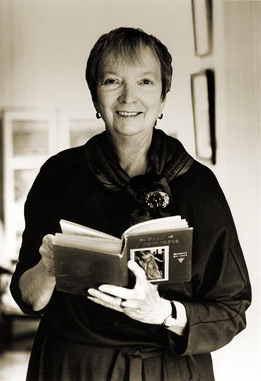
Madeleine L'Engle:
1918-2007


REFERENCES:

[Review of the book A Wrinkle in Time by Madeleine L'Engle].  Retrieved from http://www.cmlibrary.org/readers_club/reviews/tresults.asp?id=1952


Wednesday, February 18, 2015

Module 4--Johnny Tremain: A Review


MODULE 4: JOHNNY TREMAIN
BY ESTHER FORBES

Forbes, E.  (1943). Johnny Tremain. Boston, Houghton Mifflin Company.

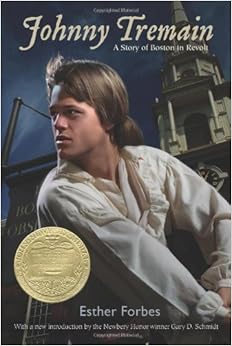
Johnny Tremain is a book detailing the early days of the American Revolution.  Its subtitle is A Story of Boston in Revolt.  It is a bit longer than I remember it, but it is still an excellent story of a young man, brought down a bit by an accident, who finds new purpose as what I would call a Grandson of Liberty.

Johnathan Lyte Tremain, generally known as Johnny, is an orphan who is apprenticed to Mr. Latham, a silversmith with two other apprentices and a large family of daughters.  Johnny is an expert apprentice, so talented that even the legendary silversmith Paul Revere knows of him.  Revere himself has offered Johnny the chance to work with him, suggesting he could go to Mr. Latham, who is showing less and less interest in running his shop, and buying the remainder of Johnny's time.  Johnny, however, feels a certain obligation to the Lathams and believes the family will starve without Johnny to do the work. 

Johnny has been a little arrogant in his way, knowing he's the best at the job.  Mr. Latham keeps warning him that pride cometh before a fall, but Johnny is too sure of himself to take this seriously.  The Lathams get a commission from John Hancock himself.  Mr. Latham has a reputation of not turning in work on time, and everyone except Mr. Latham is concerned about not finishing the work for one of the wealthiest men in town.  With the consent of Mrs. Latham, Johnny works on the Sabbath (which is illegal in Boston at the time); however, Johnny is injured while working.  One of the other apprentices, Dove, wanted to teach Johnny a lesson by handing him a cracked crucible.  Johnny's hand is violently injured and becomes useless for silversmith work or most work really.

As a result, Johnny slips into a terrible depression.  Mr. Latham wants him to stay on as long as he needs, but Mrs. Latham wants him to go and thinks he will eventually slip into crime.  Johnny wanders about Boston, looking for something he can do.  Eventually, he seeks out a distant relative, Mr. Lyte, whom his late mother told him to go to when there was simply no other way out.  He was to show a silver cup that was in Johnny's family that belongs to the larger Lyte family, proving they are related.  Mr. Lyte, however, is a greedy man, and accuses Johnny of stealing the cup.  Only the fact that Johnny had shown the cup to Cilla, one of the Latham daughters, prior to meeting Lyte saves him from the gallows.

Rafe Spall as John Hancock in
Sons of Liberty
Johnny is still in need of work, and eventually he comes to be at the Boston Observer, a newspaper that is passionately Whig (pro-independence from the British Crown).  Rab, the printer's apprentice, is passionately pro-Sons of Liberty but generally reserved and unruffled.  Soon Johnny, who knows little of politics, becomes passionately Whig, him too swept up by the words and thoughts of people like Revere, Hancock, and Samuel Adams, all of whom he's met and has done work for.

Johnny's pro-independence work includes participating in the Boston Tea Party, doing a bit of spy work for the Sons of Liberty, passing messages for the Committee of Correspondence, and serving special punch for Observer meetings, with members so secret their names are not written down.  Finally, the 19th of April, 1775 arrives, and while Johnny was not there when 'the shot heard round the world' was fired, he is there in the aftermath.  Cilla, who was taken as a maid by Johnny's distant relative, the beautiful Lavinia Lyte, and Johnny eventually do fall in love.   Lavinia decides to leave Boston for London (where she was a hit in society), taking both her very ill father and Isannah, Cilla's younger sister who is enchanted by all the pretty things.  Rab is killed at Lexington, and while Johnny is sad, he gets good news from Dr. Joseph Warren: his hand injury is not as bad as he thinks.  With simple surgery, Johnny Tremain may not fully return to silversmithing, but he can fire a musket.

Johnny Tremain I think did a better job in mixing fact and fiction regarding the American Revolution than the recent Sons of Liberty miniseries.  While the miniseries was entertaining, even exciting, the idea of turning the intellectual Samuel Adams into a hot action star, leaping roofs almost Spider-Man like, would have astounded Adams (given he was 43 when he was alleged to be flying through the air with the greatest of ease, something I'd like to do at MY age, let alone at 43).  It might even have made him laugh (though I imagine having him played by a British actor would have angered him).

Johnny Tremain, on the other hand, works as a true historic fiction and a wonderful introduction for children to American history. I think this is because we get to see events through fiction eyes with the real-life characters integrated naturally rather than altering the real-life figures to fit a narrative.  John Hancock for example, went into the Latham shop for business, which would be reasonable.  As Johnny was an apprentice silversmith, it isn't too far-fetched to imagine Paul Revere knowing Johnny by reputation.  Johnny hears Sam Adams speak, and all these things Forbes integrates into the plot easily.  I think because Johnny is fictional, and because the American Revolution is a part of the story, not the whole story itself, Johnny Tremain keeps a better balance overall.


Johnny Tremain is not just about the early days of the American Revolution. It is also about young Johnny's journey from the heights of hope to the depths of despair.  Starting out as a cocky fourteen year old, his injury is debilitating not just physically but emotionally.  His whole identity is wrapped around being a silversmith, of making great work.  Once his hand was crippled, he became crippled.  Forbes doesn't shy away from showing Johnny in despair, who has reached the end of his rope and is struggling to survive and build a new life.  Forbes slowly but surely builds Johnny back up in a realistic manner.  She allows Johnny and even Rab a moment of levity when Rab takes Johnny to a family reunion and both dance joyfully with all the pretty girls.

About the only flaw I can find is that Johnny Tremain felt a lot longer than when I first read it.  However, I still enjoyed the book very much and think boys in particular will like it.  The main character is relatable, there is action, a realistic romance that plays out slowly but believably, and we get introduced to important historical figures...no leaping on rooftops required.

BRIEF REVIEW DISCUSSION

The Kirkus Review for Johnny Tremain commented that "the story is slight, the romance slighter."  This I think is not entirely accurate.  I found the story quite rich both in detail and in history.  However, the romance is not a major part of either Johnny Tremain the character or Johnny Tremain the book.   The book is more about Johnny's dual evolution: from the cocky apprentice to the humbled destitute boy and back to a more confident patriot, and as an apolitical figure to a fierce Revolutionary who now takes arms against the British.  The romance is I think secondary.  It provides an entry to the larger Latham story than his own tenuous connection, but I think the romance worked well.  It was quiet, slowly evolving like many romances, and leaves the reader wondering whether Johnny and Cilla will get together.  In short, it was more about the Revolution than about romance, so the idea that the romance storyline was 'slight', while accurate, is I think a bit misguided.

PROGRAMMING SUGGESTIONS 

I think a couple of good programs would be to have a silver display or invite American Revolution re-enactors to present.  Since we have the Boston Tea Party part of the plot, I would recommend having an actual tea party, complete with costumes to match Lavinia and Izzy's wardrobe.  It might also be good to invite a band to perform patriotic songs, including the theme heard in Johnny Tremain as the British march out of Boston: Yankee Doodle.    

REFERENCES:

Book Review: Johnny Tremain by Esther Forbes.  Kirkus Reviews.  Retrieved from https://www.kirkusreviews.com/book-reviews/esther-forbes-5/johnny-tremain-2/

Esther Forbes
1891-1967

Tuesday, February 10, 2015

Module 2--The Westing Game: A Review


MODULE 2:
THE WESTING GAME
 by Ellen Raskin

Raskin, E. (1978).  The Westing Game.  E.P. Dutton: New York

The Westing Game is a child-centric mystery which has touches of And Then There Were None and The Casual Vacancy (though the latter was written long after The Westing Game) while I found it sometimes a dull read I also found that at times it was actually a bit clever.

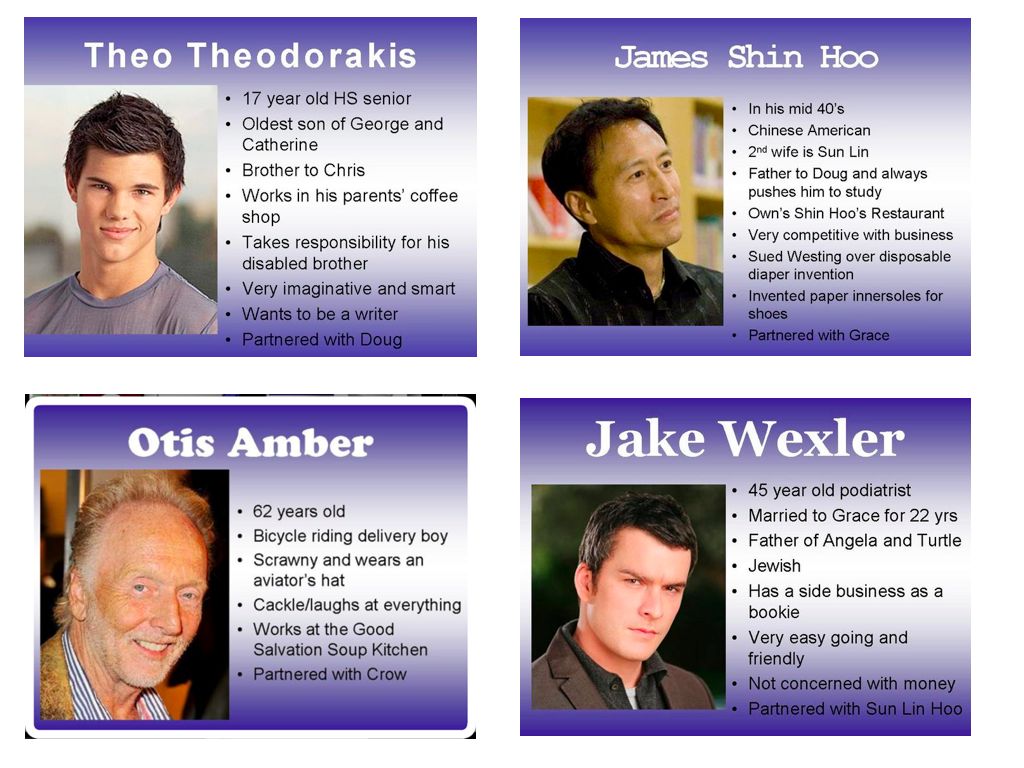
Sixteen different people, some as families, some as singles, are brought together to live at Sunset Towers, a new high-rise apartment complex facing Lake Michigan and the home of Sam Westing, a fabulously wealthy but reclusive individual.  The various families live and sometimes work at Sunset.  There are the Hoos: son Doug, a track star, is a bit of a disappointment to his father James, who would rather his son help him and his new (and younger) Chinese wife at their restaurant on the top floor.  James also dislikes the competition he's getting from the coffee shop at the ground floor, run by the Theodorakis family: Theo, an aspiring writer, his disabled brother Chris, and their father George. 

Also in the apartment is the Wexler family: podiatrist Jake (also a bookie), his uppity wife Grace, and their two daughters: the beautiful Angela and the miscreant Turtle (Tabitha-Ruth), who is passionate about the stock market despite being 13.  We also have seamstress Flora Baumbach, judge J.J. Ford, cleaning lady Berthe Erica Crow, doorman Sandy McSoutherns, delivery boy Otis Amber (boy being a misnomer given he's in his sixties) and Sydell Pulaski, a secretary who craves attention but was inserted into the Westing game by mistake.  Sydell was mistaken for a Sybil Pulaski when the group was brought together.

At first, the neighbors rarely interact, until they are named heirs to the Westing fortune.  However, Samuel Westing in his will tells them that he was really murdered...by one of them!  Further, in order to get the money they will be paired off, given a set number of clues, and then attempt from those clues to solve Westing's 'murder'.  We get them becoming suspicious of each other, there are few bombs that go off that except for Angela cause no real harm, and we find that the characters are in one way or another connected to the Westing family.  In the end, only Turtle really finds out the truth about Westing, but keeps her promise to remain silent.  We learn the fates of everyone involved in the Westing game in the end.


I don't know why The Westing Game is so beloved by people.  I remember back in middle school a lot of my friends/classmates read or knew about The Westing Game.  I didn't read it back then, and perhaps I would have enjoyed it if I had since back then, I was crazy about Agatha Christie.  However, reading it now I find it parts idiotic, parts mean-spirited.  The clues as I read them were clearly connected to the song America the Beautiful, but I kept wondering why none of the other characters until late in the game managed to think that.  Now, it might be that Raskin wanted the reader to know all that.  It is also true that the reader had all the clues while the characters just had a few.  However, even when I read just one or two of the groups America the Beautiful was the first thing to pop to mind, which made one of the character's names (Otis Amber) a really easy clue to figure out. 

I said it had similarities, to me at least, to J.K. Rowling's The Casual Vacancy, and that has to do with the fact that I found pretty much everyone in the book unlikable.  Turtle I figure was suppose to be humorous in that she would kick anyone in the shins if they pulled her braids, but in the book, but I found her more annoying than endearing.  Granted, she did cover up for the real bomber, but I wasn't too thrilled with the idea of bombing in general (as benign as they might be).  Her mother Grace was the worst: virtually ignoring Turtle for the sake of Angela (who was pushed into marriage to the intern Dr. Deere, a real doctor, not like her unfortunately podiatrist husband), she was in many ways quite bigoted.  She wasn't too thrilled with the idea that her husband was Jewish, and made assumptions about Asians.  Crowe's religious fanaticism also didn't sit well with me, as if it were somehow mocking Christians as these wild-eyed loons.  Chris Theodorakis, who is disabled, is a result of an accident that left him both incapable of controlling his body and with a speech impediment.  That struck me as close to ridiculing the disabled.  Yes, he was really bright and in the end he got something of a cure (he never walked again but the spasms and speech were kept in control), but I still wasn't fond of it.

Raskin also used some now-unacceptable terms when describing people.  Flora's daughter died prior to the events of The Westing Game, and the child is referred to as a "Mongoloid", which for people with Down's Syndrome I think is a slur. 

I had some questions about the plot as well.  Why go through all these bombings which if memory serves correct weren't connected or thinly connected to the mystery?  In the will, we get stage directions written into it (at one point, the lawyer reads from the text of the will, "Sit down Grace Wexler", but I think it's a little TOO convenient to know Grace would stand up in shock).

I did find the bit about 'directions' to be clever and something I wasn't expecting.   I also liked the fact that just about everyone, even the variations of Westing, got a happy ending of sorts.  I also as I noted said it reminded me of And Then There Were None in how all the characters are connected in a roundabout way. 

However, on the whole I was surprised at the violence within it (all those bombs, one which left Angela scarred for life), I thought the plot didn't hold well together.  I didn't care who won the Westing Game and felt it buildup and praise for it is extremely exaggerated.

BRIEF REVIEW DISCUSSION

I find that in the last point, I am in the minority.  Elizabeth Bird, a New York City Public Library Youth Materials Collection Specialist, praised it as an ode to capitalism.  Roberto De Leon, a public library teacher, noted like I did the similarity to a Christie novel ("an elaborate homage to her favorite author Agatha Christie", he called it), and went on to call The Westing Game a masterpiece.  I wouldn't go that far.  I think younger readers might enjoy it, but for myself, I found no pleasure in The Westing Game and find it a terrible disappointment.   I do, however, see how it is similar to an Agatha Christie novel: a variety of suspects, many with secrets but not strictly connected to the crime, and gathering them to solve the crime.

PROGRAMMING SUGGESTIONS

As for any use in the library, perhaps a display for mystery novels would work.  I could offer also a scavenger hunt for clues, complete with a shadowy figure giving clues for prizes, or even a singing of America the Beautiful as it was a major plot point. 


Ellen Raskin
1928-1984


REFERENCES:

Bird, E. (2012).  Top 100 Children's Novels #9: The Westing Game by Ellen Raskin.  A Fuse 8 Production. 

http://blogs.slj.com/afuse8production/2012/06/17/top-100-childrens-novels-9-the-westing-game-by-ellen-raskin/#_

De Leon, R. (2013).  A Nerdy Retro Review of Ellen Raskin's The Westing Game.  Nerdy Book Club. 

https://nerdybookclub.wordpress.com/2013/11/19/a-nerdy-retro-review-of-ellen-raskins-the-westing-game-by-roberto-de-leon/