Showing posts with label Fiction. Show all posts

Monday, July 20, 2015

Freedom Summer: A Review


Wiles, D. (2001).  Freedom Summer.  Aladdin Paperbacks, New York.  Illustrated by Jerome Lagarrigue.

It's a bit sad that Freedom Summer came when it did.  I had requested from the El Paso Public Library around March, and it finally came in in July.  It took all that time after my request for a copy to be found, despite there being a few listed among the EPPL's collection.  In any case, we at last are able to look at Freedom Summer, the story of two boys and their friendship.  One is white, one is black, and that is what makes this friendship so unique in its time.

Joe, the narrator, talks about his best friend, John Henry Waddell.   He is the son of the family maid, Aunt Mae.  Joe and John Henry spend their days going to the local creek to swim, and then Joe gets ice cream for himself and John Henry, who being black, cannot go in.

One night at dinner, Joe learns that a new law will allow blacks to go to all public places.  That includes the local swimming pool.  Joe is so excited because now John Henry will be able to go there, and they can swim together at the pool.  When they get to the pool, however, they find that the pool was being filled in with tar.  The local government has decided to close the pool rather than allow blacks to swim.  John Henry and Joe can only sit at the diving board and look on the filled-in pool.  Joe tries to comfort John Henry by suggesting they go back to the creek, but John Henry makes it clear he wanted to go into the pool. 

With that, Joe decides to take John Henry to get ice cream, and to go in together.


Freedom Summer is a simple story told simply and sweetly.  It is easy for children to read, using simple words that they will understand.

The subject matter is hard for children today to understand.  We are long gone from the time of legal segregation, and Freedom Summer has an opening statement attempting to make clear what the laws were at the time desegregation took place.  Deborah Wiles mentions also that some businesses and locations closed, some permanently, rather than integrate.

I don't see a flaw with Freedom Summer, perhaps apart from the idea that Joe would want to see the world through John Henry's eyes.  Try as he might, Joe will never be able to see it with that vision because as a white boy, he has an advantage that John Henry will not have, at least until a generational change allows for it. I do find it a bit odd that Joe wouldn't see the difficulty of integration coming one day to the next. 

Again, children are not born with prejudices.  They are blessed with being free of preconceptions that plague the 'wiser' adults.  They see things from different eyes.  As such, Joe might not have understood that people would object to John Henry going to the pool.  He knew enough to know John Henry couldn't go into the ice cream shop with him.  He did understand how things work, but when it comes to the pool, he didn't.  I found that a bit odd.

On the whole though, Freedom Summer has a positive message to give and tells it in a way children will understand.  It ends on a positive note, with Joe inviting John Henry to go into the ice cream shop together.  It's a small step to racial equality, but they are small boys.  


Sunday, July 19, 2015

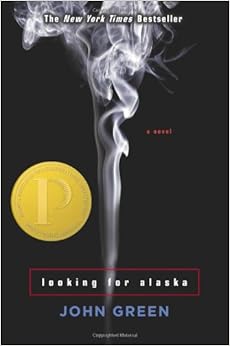
Looking For Alaska: A Review


Green, J. (2005). Looking For Alaska.  Penguin Random House, New York.

Has it really been only ten years since John Green's debut novel, Looking for Alaska, was published?  Ten years since the Illustrious Mr. Green sprouted his other works, like Paper Towns, An Abundance of Katherines, and the "Citizen Kane" of teen novels (at least to him), The Fault in Our Stars?  If you note a certain sarcasm about Green, it's because I have it.  I only saw the film version of The Fault in Our Stars, and to be honest, I found much fault in the film. Quoting Shakespeare doesn't mean BEING Shakespeare, even to a group of dimwitted teens.  Looking for Alaska, based partially on Green's own experiences at boarding school, is a book beloved by many: readers and critics alike. 

Sorry, I'm not in either group.

Miles Halter leaves his public high school in Florida to go the Culver Creek Preparatory High School in Alabama, which was his father's alma mater.  He goes seeking "the Great Perhaps", an answer to what is 'out there', beyond this mortal coil.  At CCPH, he rooms with Chip Martin, nicknamed "The Colonel".  The Colonel takes one look at skinny Miles Halter and instantly dubs him "Pudge".  Miles/Pudge also meets three other people who will be important: the Japanese student/beat-box impresario Takumi, the beautiful Romanian student Lara (who has an accent), and Alaska Young.

Ah, Alaska Young.  The beautiful, enigmatic, troubled, fascinating, erotic Alaska Young.  Pudge is instantly drawn to this figure who is hard to figure out.  She drinks, she smokes, she is someone Pudge finds desirable sexually and emotionally (despite her being a basketcase).  While she has a boyfriend, a college student named Jake, Alaska can be coy with our innocent narrator Miles.  Pudge has a fixation with people's last words, so much so that he only reads the ends of biographies to find what was the last thing they said.  Perhaps there are words of wisdom within them that he can draw from (his seeking "the Great Perhaps" comes from someone's last words).  Alaska, learning this, gives him what are reportedly Simon Bolivar's last words, "How can I ever get out of this labyrinth?"


This Collective as I call it is forever at war with The Weekday Warriors, those wealthy kids who leave Culver Creek on the weekends.  The group Pudge finds himself in performs pranks on the Weekday Warriors, especially after a couple of them, for retribution for something done last year, almost end up drowning poor Pudge (who just got there).  As time goes by, with Pudge introduced to the wonders of drinking, smoking, and near the middle part of the book, a blowjob (thanks, Romanian beauty queen), he still can't let go of his idea of Alaska.  Alaska: the girl with the tragic history, who watched her mother die and was so paralyzed with fear and shock she didn't call the police for help.  The Colonel, a short guy with a chip on his shoulder (get it, "Chip"), wants to show up his hoity-toity classmates. 

Then comes The Day.  A drunk Alaska finally grants Pudge what he's long longed for: a passionate make-out session.  She promises that this is 'to be continued', but later that night an even drunker Alaska comes in, hysterical and screaming.  Despite her being visibly intoxicated and highly emotional, Pudge and the Colonel help her drive out of Culver Creek by distracting The Eagle (the headmaster).  The last thing she says to them is "God oh God,  I'm so sorry."

The next day, the school learns that she was killed in a car accident, her having run headfirst into a police car that was investigating a jackknifed truck.  A group of flowers was found in her car.

The rest of Looking for Alaska involves the Colonel and Pudge attempting to investigate the real cause of death.  Was it perhaps suicide?  Why was Alaska so hysterical?  Miles' own questioning of where Alaska went (if she went anywhere, since Miles has no belief in the afterlife) as well as his own guilt about letting her drive off in that condition plague him.  He ignores Lara, who was something of a girlfriend to him.  The Investigation is about the only thing that keeps him going, that an a posthumous prank from Alaska Young involving a male stripper posing as a Professor of Psychology specializing in teenagers and sexuality.  He begins what sounds like a typical speech, but when Lara, preplanned, shouts for him to take his clothes off, Maxx the Stripper goes full Channing Tatum.  As no one can be specifically pointed out to be the mastermind, no one gets punished.

In the end, Takumi provides clues to The Investigation.  We discover that the night of Alaska's death was the anniversary of her mother's death.  She had always placed flowers on her mother's grave on the anniversary, but this year she forgot.  In her distraught state, she may have gone to try and place them now, or perhaps Alaska did really aim for the police car out of guilt.  In any case, Alaska is dead, as is Miles' idealization of her. He reconciles himself to that.


What I find hard about Young Adult novels in general is the idea that teens have greater insight and wisdom than everyone else despite their lack of actual life.  Green if anything, appears to be a master of encouraging teens to think they have special insight into the world.  In fact, Pudge's summing up of the whole matter in a letter to the Colonel before he leaves for home at term's end pretty much states so.
"And if Alaska took her own life, that is the hope I wish I could have given her.  Forgetting her mother, failing her mother and her friends and herself--those are awful things, but she did not need to fold into herself and self-destruct.  Those awful things are survivable, because we are as indestructible as we believe ourselves to be.  When adults say, "Teenagers think they are invincible" with that sly, stupid smile on their faces, they don't know how right they are.  We need never be hopeless, because we can never be irreparably broken, We think that we are invincible because we are.  We cannot be born, and we cannot die".


Gobbledygook, I says, and phooey on Green for pushing such ideas.  I'm tired of teens and the writers who love them too much pushing this narrative that the young know more than the old, and that somehow their own little world is the real world.  Teens are quite destructible.  Adults are quite destructible.  We can choose to be destroyed by the forces oppressing us, or we can accept that the world is something we can make into something beautiful or something awful.  We have the power of choice.  Alaska's choice was simple: to drink too much, smoke too much, tease Pudge, and then collapse when she remembered what she had forgotten.  Pudge and the Colonel, and Takumi's choices were also easy: they could have stopped Alaska from driving.  They all had a hand in Alaska's death, and they proved that Alaska was quite destructible.

I tire of teenagers who think they know all the answers to all the questions, and especially of those who coddle such notions.

In a sense, Alaska did kill herself, but not perhaps by deliberately running into the police car.  She killed herself long before getting behind the wheel, by drinking too much to drown the guilt she had over something she could not control.  It's interesting that Alaska's inability to call 911 when her mother died mirrors Ray Charles' inability to call for help when his younger brother drowned in the tub (the film Ray, which came out in 2004, came to mind for some reason).  Ray Charles not only carried the guilt about that, but he even went blind.  Yet, despite all that (and being black to boot), Ray Charles not only managed to survive, but thrive.  Alaska, a white girl who manages to go to a posh school which probably costs her father a pretty penny, can't.

We all suffer loss, we all suffer pain.  We can shoulder it in many ways: family, friends, faith.  Alaska had a few of the second, at least one of the first, but none of the third.  She did have the bottle and the smokes, which make for a poor substitute.

I never understood Pudge's idealization of Alaska. Yes, she must have been quite beautiful physically, but she was also openly troubled from the get-go.  He must be a particularly weak person to not say at one point that Alaska was trouble.  He never objected to any of the Colonel's stunts or in the drinking and smoking which he was introduced to (as a side note, I managed to go through high school without drinking or smoking, but then, I went to public high school).  Perhaps though, I should not be too hard on that subject.  We all have a tendency to romanticize the past, to idealize someone at some point.  Most of us though, get over it.

I find it interesting that Pudge is bothered by the fact that he will never know Alaska's final words.  Actually, let me field that question.  Pudge DOES know Alaska's final words.  They were, "God oh God, I'm so sorry".  As there was no one else to hear anything else she said, those would be the final recorded words of Alaska Young.  I don't understand why Green doesn't allow Pudge to accept that those were her final words.

What I found was that Pudge and Company were themselves a bit elitist.  They held contempt for the Weekday Warriors to where they were angered that they would cry at the news of Alaska's death.  I found that the Colonel's crew had no compassion themselves.  Why couldn't the Weekday Warriors cry?  They, and I am speculating on this, weren't crying specifically for Alaska.  They were crying for themselves, for the fact that death now had become something real, something they had to face.  They now knew they were quite destructible.  Also, there is something called empathy.  I have cried at the deaths of people I don't know (like those women stoned to death or gay men tossed off buildings by ISIS).  According to Green though, I cannot do such things as feel for others.  I can only cry for those I know.

OK, I'll grant that perhaps since this is told from Miles' perspective this would be a natural reaction to seeing his 'enemies' cry at the death of his friend.  Still, that bothered me, the idea that one could not empathize for someone else.

Looking for Alaska has what I think has become a template for modern YA books: insecure boy, enigmatic girl, offbeat friends fighting against the 'cool kids', some sex, good amount of booze and smokes (legal and otherwise), with occasional dead people thrown in.  Based on my memories of the film I don't find much difference between Looking for Alaska and The Perks of Being a Wallflower.  There are differences, of course, between them.  However, in many respects they share similar traits.

I admit to not finding Catcher in the Rye all that great, primarily because I read it in my thirties, not my teens.  Perhaps if I had read Looking for Alaska when I was in high school, I would have been as enamored of it (and of John Green as the literary light he sees himself as) as the many teens who swoon over people their own age who know they are indestructible.  I can see the appeal of these kinds of books: with their 'wisdom' about the struggles of rich and middle-class white children (curious how Green has few if any minorities in his books, as far as I know.  White privilege, anyone?).  For myself, I found Pudge's search for The Great Perhaps dull and slightly narcissistic, as if he was the first to ever fall in love with an idea or know of death at a young age. I found it all a little smug, a little condescending, and frankly I can live with the idea that Alaska died because she drove drunk, not because of her own inward guilt.

Hey, Johnny...I have a few last words for you.  They are John Wilkes Booth's final words, as he looked on his hands as he lay dying. 

"Useless.  Useless".

Born 1977

Heaven help us if HE becomes 'the voice of our generation'.


Wednesday, February 18, 2015

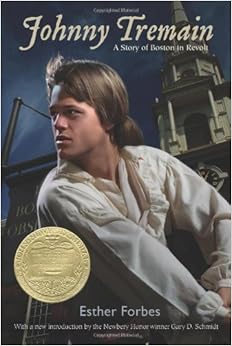
Module 4--Johnny Tremain: A Review


MODULE 4: JOHNNY TREMAIN
BY ESTHER FORBES

Forbes, E.  (1943). Johnny Tremain. Boston, Houghton Mifflin Company.

Johnny Tremain is a book detailing the early days of the American Revolution.  Its subtitle is A Story of Boston in Revolt.  It is a bit longer than I remember it, but it is still an excellent story of a young man, brought down a bit by an accident, who finds new purpose as what I would call a Grandson of Liberty.

Johnathan Lyte Tremain, generally known as Johnny, is an orphan who is apprenticed to Mr. Latham, a silversmith with two other apprentices and a large family of daughters.  Johnny is an expert apprentice, so talented that even the legendary silversmith Paul Revere knows of him.  Revere himself has offered Johnny the chance to work with him, suggesting he could go to Mr. Latham, who is showing less and less interest in running his shop, and buying the remainder of Johnny's time.  Johnny, however, feels a certain obligation to the Lathams and believes the family will starve without Johnny to do the work. 

Johnny has been a little arrogant in his way, knowing he's the best at the job.  Mr. Latham keeps warning him that pride cometh before a fall, but Johnny is too sure of himself to take this seriously.  The Lathams get a commission from John Hancock himself.  Mr. Latham has a reputation of not turning in work on time, and everyone except Mr. Latham is concerned about not finishing the work for one of the wealthiest men in town.  With the consent of Mrs. Latham, Johnny works on the Sabbath (which is illegal in Boston at the time); however, Johnny is injured while working.  One of the other apprentices, Dove, wanted to teach Johnny a lesson by handing him a cracked crucible.  Johnny's hand is violently injured and becomes useless for silversmith work or most work really.

As a result, Johnny slips into a terrible depression.  Mr. Latham wants him to stay on as long as he needs, but Mrs. Latham wants him to go and thinks he will eventually slip into crime.  Johnny wanders about Boston, looking for something he can do.  Eventually, he seeks out a distant relative, Mr. Lyte, whom his late mother told him to go to when there was simply no other way out.  He was to show a silver cup that was in Johnny's family that belongs to the larger Lyte family, proving they are related.  Mr. Lyte, however, is a greedy man, and accuses Johnny of stealing the cup.  Only the fact that Johnny had shown the cup to Cilla, one of the Latham daughters, prior to meeting Lyte saves him from the gallows.

Rafe Spall as John Hancock in
Sons of Liberty
Johnny is still in need of work, and eventually he comes to be at the Boston Observer, a newspaper that is passionately Whig (pro-independence from the British Crown).  Rab, the printer's apprentice, is passionately pro-Sons of Liberty but generally reserved and unruffled.  Soon Johnny, who knows little of politics, becomes passionately Whig, him too swept up by the words and thoughts of people like Revere, Hancock, and Samuel Adams, all of whom he's met and has done work for.

Johnny's pro-independence work includes participating in the Boston Tea Party, doing a bit of spy work for the Sons of Liberty, passing messages for the Committee of Correspondence, and serving special punch for Observer meetings, with members so secret their names are not written down.  Finally, the 19th of April, 1775 arrives, and while Johnny was not there when 'the shot heard round the world' was fired, he is there in the aftermath.  Cilla, who was taken as a maid by Johnny's distant relative, the beautiful Lavinia Lyte, and Johnny eventually do fall in love.   Lavinia decides to leave Boston for London (where she was a hit in society), taking both her very ill father and Isannah, Cilla's younger sister who is enchanted by all the pretty things.  Rab is killed at Lexington, and while Johnny is sad, he gets good news from Dr. Joseph Warren: his hand injury is not as bad as he thinks.  With simple surgery, Johnny Tremain may not fully return to silversmithing, but he can fire a musket.

Johnny Tremain I think did a better job in mixing fact and fiction regarding the American Revolution than the recent Sons of Liberty miniseries.  While the miniseries was entertaining, even exciting, the idea of turning the intellectual Samuel Adams into a hot action star, leaping roofs almost Spider-Man like, would have astounded Adams (given he was 43 when he was alleged to be flying through the air with the greatest of ease, something I'd like to do at MY age, let alone at 43).  It might even have made him laugh (though I imagine having him played by a British actor would have angered him).

Johnny Tremain, on the other hand, works as a true historic fiction and a wonderful introduction for children to American history. I think this is because we get to see events through fiction eyes with the real-life characters integrated naturally rather than altering the real-life figures to fit a narrative.  John Hancock for example, went into the Latham shop for business, which would be reasonable.  As Johnny was an apprentice silversmith, it isn't too far-fetched to imagine Paul Revere knowing Johnny by reputation.  Johnny hears Sam Adams speak, and all these things Forbes integrates into the plot easily.  I think because Johnny is fictional, and because the American Revolution is a part of the story, not the whole story itself, Johnny Tremain keeps a better balance overall.


Johnny Tremain is not just about the early days of the American Revolution. It is also about young Johnny's journey from the heights of hope to the depths of despair.  Starting out as a cocky fourteen year old, his injury is debilitating not just physically but emotionally.  His whole identity is wrapped around being a silversmith, of making great work.  Once his hand was crippled, he became crippled.  Forbes doesn't shy away from showing Johnny in despair, who has reached the end of his rope and is struggling to survive and build a new life.  Forbes slowly but surely builds Johnny back up in a realistic manner.  She allows Johnny and even Rab a moment of levity when Rab takes Johnny to a family reunion and both dance joyfully with all the pretty girls.

About the only flaw I can find is that Johnny Tremain felt a lot longer than when I first read it.  However, I still enjoyed the book very much and think boys in particular will like it.  The main character is relatable, there is action, a realistic romance that plays out slowly but believably, and we get introduced to important historical figures...no leaping on rooftops required.

BRIEF REVIEW DISCUSSION

The Kirkus Review for Johnny Tremain commented that "the story is slight, the romance slighter."  This I think is not entirely accurate.  I found the story quite rich both in detail and in history.  However, the romance is not a major part of either Johnny Tremain the character or Johnny Tremain the book.   The book is more about Johnny's dual evolution: from the cocky apprentice to the humbled destitute boy and back to a more confident patriot, and as an apolitical figure to a fierce Revolutionary who now takes arms against the British.  The romance is I think secondary.  It provides an entry to the larger Latham story than his own tenuous connection, but I think the romance worked well.  It was quiet, slowly evolving like many romances, and leaves the reader wondering whether Johnny and Cilla will get together.  In short, it was more about the Revolution than about romance, so the idea that the romance storyline was 'slight', while accurate, is I think a bit misguided.

PROGRAMMING SUGGESTIONS 

I think a couple of good programs would be to have a silver display or invite American Revolution re-enactors to present.  Since we have the Boston Tea Party part of the plot, I would recommend having an actual tea party, complete with costumes to match Lavinia and Izzy's wardrobe.  It might also be good to invite a band to perform patriotic songs, including the theme heard in Johnny Tremain as the British march out of Boston: Yankee Doodle.    

REFERENCES:

Book Review: Johnny Tremain by Esther Forbes.  Kirkus Reviews.  Retrieved from https://www.kirkusreviews.com/book-reviews/esther-forbes-5/johnny-tremain-2/

Esther Forbes
1891-1967

Tuesday, December 9, 2014

Hondo by Louis L'Amour: A Review


Hondo by Louis L’Amour


1.      Bibliographical Information


L’Amour, L. (1953, 1997). Hondo. New York, New York. Bantam Bell, a division of Random House, Inc.


ISBN 0-553-80299-2


2.      Summary


Hondo Lane is a man of the West: stoic, quiet, who comes and goes when and where he needs to.  He has no family and no friends (though he does know people).  In fact, his only real companion is Sam, a dog who goes with him and resembles him in almost every way (for example, he doesn’t like to be petted).  Hondo, who has some Native American blood and both has lived with and knows the way of the Apache, wanders into a small ranch whose only inhabitants are Angie Lowe and her son Johnny.  Her husband has gone but she knows not where or when he will return.  Hondo does not understand how any man could leave a woman, especially one as fit to the West as Angie, with her determination to live on the land, to her own devices.  He is there only one day, but he kisses her before he goes, telling her a woman should be kissed like a woman should at least once.  Angie is full of her own conflicted emotions, seeing in Hondo someone worthy of both her love and Johnny’s admiration.  Hondo, however, has to go, for he has served as a scout to a nearby fort.  He offers Angie a chance to leave, for the Apache are on the attack, but she is rooted to the land and the hope her husband returns, so she declines.  Hondo, back at the fort, learns of a massacre by the Apache and their leader, Vittoro.  In town, Hondo forces a card shark and his associate to stop taking advantage of someone else, and they secretly follow Hondo into the desert despite the Apache.  Killing both in self-defense, Hondo discovers the main attacker was Ed Lowe, Angie’s husband (a picture of Johnny was with him).  Hondo, upset about having killed the husband of the woman he loves, is conflicted.  However, Angie has her own problems, as Vittoro has come to her ranch.  Johnny defends his mother against a ruthless Apache named Silva, and Vittoro, amused that a child could take down one of his great warriors, makes Johnny (or Small Warrior as he dubs him) his blood brother.  However, Vittoro also thinks Angie should have a man, offering one of his warriors.  Angie demurs but after Hondo is captured and brought to the ranch, she claims Hondo to be her husband.  Hondo begins to trail Johnny in the ways of the West, but the Army moves in and orders them out when they take an offensive against Vittoro.  In that battle, Vittoro is killed but Silva takes control.  As they ride out to safety at another fort, Silva attacks, and Hondo spears him like Silva killed Sam.  Angie, who knows by now the truth but knows what kind of man Hondo is, along with Johnny, ride off to the nearest fort, with the idea of going to California and Hondo’s own place.


3.      Comparison of Characteristics


Hondo has every characteristic associated with the Western.  First, the location is the American Southwest, with L’Amour’s poetic description of the desert.  These are figures who are either tied to the land or intimately aware of the importance of the land.  Hondo is the quintessential Western hero: quiet, guarded, with a code that he won’t violate.  We also have Indians who are also antagonists but not the only ones.  Vittoro is wise with his own codes, Silva being brutal and uncaring.  The story also has straightforward characters: Ed and Silva are bad, Hondo and Vittoro are good.  There are few shades of grey with them.  Angie is also heroic: she uses her inner strength and wits to keep the Apache waiting. 


4.      My Reaction


I knew of Louis L’Amour by reputation, and Hondo was my first L’Amour book.  I highly enjoyed it and thought it an excellent book.  L’Amour’s story reminds me a bit of the myth of Odysseus, with faithful Penelope waiting for the hero to return as Vittoro brings suitors to raise his blood brother.  I liked the fact that unlike traditional images of Native Americans, they were not all villains (and that Vittoro spoke perfect English).  I liked that L’Amour created extremely poetic turns of phrases.  As Ed and his partner Phalinger sleep before attempting to attack Hondo, L’Amour writes, “Under a quiet sky the planet turned, and horses ate, and men slept, and death waited for morning”.  L’Amour’s writing is sparse, simple, but extremely descriptive and poetic.  We also get brief insights into the minor characters like Phalinger, whom you feel sympathy for because L’Amour has us know he has learned too late the error of his ways.  I felt sad for him, and for Sam when Silva kills him.  L’Amour uses language beautifully and paints the characters in broad strokes but enough to understand what kind of people they are.  If Hondo has any flaws, it is that the ending seems a little abrupt, where the final battle between Silva and Hondo and the troops seems to happen almost as a way to wrap up the story.  Minus that, Hondo is a brilliant story that I got into and that flowed quickly.   When it comes to Westerns, one simply can’t go wrong with Louis L’Amour, whom I think should be the first name recommended for the genre.


5.      Comparison to Other Genres


Fans of Westerns will love Hondo, and I think the book will also appeal to those who like romances.   The story between Hondo and Angie is simple and romantic.  You understand that they should be together from almost the very beginning, and that Hondo would be the perfect father to Johnny.  Hondo could easily be a romance that women could enjoy.  Hondo has a strong hero, a strong woman, and both who yearn for love and each other. 


Saturday, May 4, 2013

Town Without Pity: The Casual Vacancy Review


THE CASUAL VACANCY by J. K. Rowling

The Casual Vacancy is a first for both J.K. Rowling and myself.  For Ms. Rowling, it is the first novel she's written post-Harry Potter, the 'children's' series that has brought her fame and wealth beyond anything most writers have or will achieve (when was the last time YOU went to a Portnoy's Complaint theme park?).  Thus, there is a lot riding on whether she can write books not 'geared' towards children. 

I say this noting that I, based on the Harry Potter films, would argue that they are not children's literature past Prisoner of Azkabahn.  Every Potter film post-Azkaban I'd say was quite adult in terms of subject, but who am I to argue with success?

For myself, this is my first Rowling book that does not involve "the boy who lived", and if I must be honest I didn't like Harry Potter and the Sorcerer's Stone (the only book in the series I have managed to finish).  There was never any mystery to it all: Harry, you're a wizard, let's move on with it.  I wasn't enchanted with the first Harry Potter book, and while I've been told by those who've read the whole series that Sorcerer's Stone is the weakest of the seven, I never had the urge to read more Harry Potter stories.

Still, that is for another time.

Thus with The Casual Vacancy, Rowling declares her freedom from make-believe.  Her first foray into adult literature proves one thing: J.K. Rowling is definitely NOT in any way a genius.  In fact, The Casual Vacancy is such an awful read that if it didn't come from the keyboard of Jo, it probably wouldn't haven been published.  There is a reason I nicknamed her "Sprawling Rowling": her tomes are always so massive that at least with The Casual Vacancy, it simply cannot carry the story she is telling.  With the myriad of interlinking stories she has in her little town of Pagford, it's not that one gets entirely lost between the Lexies and Sukvinders and Fats and Robbies rolling around.  It's that they are more stick figures for Rowling to play with.

This is what I have always felt about Rowling: she has great ideas for books, she just never has great books to match them. 

Now, a Venn diagram would be invaluable to follow the various characters in Casual Vacancy.  One can start with any of them and shift from Person A to Person Z without breaking the chain.  Let's start with Andrew Price.  He is a teenager, one with strong acne, whose father Simon is as abusive as they come: physically beating his wife and sons, emotionally belittling them at every opportunity (for example, calling his youngest son 'Pauline' to his face).  Andrew is passionately in lust with Gaia Bawden, recently from London, though not by her own choice.  Gaia's mother Kay has moved on down to the seemingly-idyllic town of Pagford following Gavin, a man she sleeps with but who, despite her general obsession with, won't even introduce her as his 'girlfriend', let alone anything else. 

Kay is the temporary social worker for the Weedons, a sorrier group of people living in The Fields, which is the estate section (what we in the States would refer to as 'the ghetto', 'the hood', or perhaps 'the barrio') of Pagford foisted on them many years ago by the larger neighboring city of Yarvil.  Terri Weedon is a heroin addict and lively tart who hides stolen goods for her...friend with some benefits Obbo and is mother to Krystal, teen, and Robbie, toddler.  Krystal is a sad mix: a slut and thief who is also the only real parent Robbie actually has. 

Krystal goes to school with Andrew and his best friend Stuart Wall, generally known as Fats.  Fats is one of those kids who thinks he is somehow beyond morality.  His parents, Colin (the school director nicknamed "Cubby" for his obsessions for 'cubby' holes) and Tessa (a guidance counselor at the school) harbor a dark secret about Stuart, who basically hates them between joint hits.

Stuart has no problems bullying Sukvinder Jawanda, another classmate who is Sikh and because of this cannot shave the small amount of facial hair she has.  To compensate, she secretly cuts herself.  Her mother, Dr. Parminder Jawanda, is oblivious to her daughter's cutting, but it probably wouldn't matter all that much to her given that of her three children, she makes it clear the ironically-nicknamed "Jolly" is by far the biggest disappointment.  Dr. Jawanda's husband, heart surgeon Vikram, is the object of lust among the WASP set of desperate housewives.

Parminder serves on the local council and her chief nemesis is Council Head Howard Mollison, owner of the local deli.  He is definitely fat, and smug, and self-righteous, and hypocritical...therefore, he's obviously Tory.  He has a business partner, Maureen, who I think is also heavy-set.  His equally large wife Shirley worships the very shadow of Howard, seeing that he can do no wrong and I mean that literally.  Their son Miles is married to Samantha, who hates Pagford, hates the Mollisons, and generally hates everything while not getting tans and boob jobs. 

Krystal and Sukvinder are on a rowing team together, organized by Barry Fairbrother, another Council member who is generally allied to Parminder.
Gaia is best friends with the shy, self-conscious Sukvinder (though more because the latter is the only 'ethnic' in town versus the uber-white village she's been dragged into).
Krystal and Fats begin having sex: he to be rebellious and she to hopefully get preggers and thus he can 'take her away from all this'.      

Andrew, who understandably hates his father, is enthralled by Gaia, but she is unaware that he masturbates to her.

Samantha is also starting to feel her Mrs. Robinson coming on, drinking heavily while lusting after Jake, a member of a boy band her daughter Lexie likes (though Lexie both prefers another band member and is totally unaware how Samantha plays the band's DVD endlessly to see an open-shirted Jake appear before her hungry mother).
Jake, is that you?


In all that description, I haven't even mentioned the actual PLOT of The Casual Vacancy, but it is important to know exactly who is who before diving into the actual sprawling story.

In a nutshell, Barry Fairbrother drops dead on his anniversary, leaving his wife Mary a despondent widow.  Fairbrother's death leaves an opening (or a Casual Vacancy) on the council, and this seat is the catalyst for an epic struggle between all these people.  For the Mollisons, it is a chance to dump The Fields to Yarvil, and to close down the drug treatment center there as well (as they happen to own the building...I think).  Parminder Jawanda is equally determined to keep The Fields and the clinic in Pagford (especially since Barry, who managed to rise from The Fields to respectability) wanted that as well. 

The election to fill this Casual Vacancy brings havoc to all the families.  Simon Price wants in, seeing it as a way to gain more financially.  Cubby Wall wants in, as a way to honor his old friend Barry.  Miles Mollison wants in, as a way to do dear old Dad's bidding.

However, the election is now a way to pick on old wounds and resentments.  Andrew, striking out against Simon through hacking into the Pagford Council website as "the Ghost of Barry Fairbrother", reveals that his dad buys stolen goods and uses the company printing machine for his own gains.  Later on, Sukvinder, also using the Ghost username (but without Andrew's knowledge) reveals that Parminder may have been in love with Barry (explaining why she always voted with him).  Finally, Fats gets in on the act, again without Andrew's assistance, revealing that Cubby is terrified that he inadvertently molested someone.

Well, as Shirley, the website's manager, is inept at stopping the Ghost from posting, the news spreads quickly.  Simon withdraws and is made redundant, with the high possibility of having to leave Pagford.  Parminder is constantly on edge, worrying about her own feelings.  Cubby now finds his obsessive-compulsive disorder going out of control, terrified that he did something wrong when it's all in his mind.

Fats and Andrew's friendship is strained when Stuart and Gaia appear to hook up despite Arf's knowledge of Andrew's fixation.  However, Stuart is too involved with Krystal to think much on it.  Neither are in love with each other but instead are using each other and not just for clumsy sex. 

To wrap things up, on a fateful day all of them collide: Kay realizes that she will never be anything to Gavin, who's convinced he's in love with Widow Fairbrother, who won't return his affection.  Stuart and Krystal go for a tryst in the bushes near the river after she ran away from Terri, taking Robbie with them.  A toddler near a river...you do the math.  A devastated Krystal deliberately overdoses on her mom's smack, even after Sukvinder did her best to come to a little one's rescue.

Oh, and Miles won the election.

    
One thing that shocked me was how any editor would not have laid down the law and told Jo that she needed to change character's names.  We have two Mollison wives: Shirley Mollison (wife of Howard) and Samantha Mollison, who had to marry Miles Mollison, the heir.  Shirley, Samantha, Samantha, Shirley...pretty soon it becomes hard to remember who is who.  Any first-year writing student would have been told that having two characters whose names start out with the same letter being so closely connected to each other might confuse the reader.  This is especially true in Casual Vacancy, where the women are either passive or passive-aggressive.

One thing that I noticed in Casual Vacancy is how Rowling loves to float between characters in the same chapter.  We start by reading what let's say Shirley thinks or feels, and then when Shirley looks or talks to Samantha we go into what Samantha thinks or feels, and if she makes a comment to Howard, now it's on to his thinking or emotional state.  One point I recall how Gavin was thinking about his feelings to Mary (who is about the only character whom we rarely if ever hear from, primarily because she isn't much featured in Casual Vacancy) as he walks her home.  I think Howard observes them (or it might have been Cubby...both are fat men) and then we start hearing what THEY think of this rather shocking development.

As someone who has barely encountered all those connected to Hogwart's, I am astounded how both shallow and similar all the Casual Vacancy characters were.  The men were almost all generally uncaring: Vikram's disinterest, Howard's selfishness, Simon's abusiveness, Gavin's ambivalence.  The women were almost all equally bad: Shirley's passivity, Terri's self-pitying, Parminder's one-track mind, Samantha's silent rage. 

There isn't one character in Casual Vacancy that I could care about.  Even the ones that could have provided some sympathy, like Krystal or Sukvinder or Andrew, were all in their own way rather horrible people.  I don't expect there to be saintly figures who do no wrong, but one would expect there to be a protagonist in a story.  Casual Vacancy doesn't have a protagonist because everyone in the story is almost universally antagonistic to someone or themselves.  In short, I didn't care who won the election, I didn't care what happened to this collection of monsters, I couldn't find sense in almost anything they desired or did.

Krystal is a clichĆ©: the girl from the wrong side of the tracks who hides her pain with sex and theft and bad behavior.  Only when Barry encourages her in her rowing and working with the team does she have any moments of humanity.  I kept hoping that perhaps Krystal would show some secret skill, some positive characteristic that would make me want her to succeed.  She never did. 

I don't think I've met a more reprehensible group of people than those in Pagford.  Truth be told, the way The Fields was described, I would have sided with the Mollisons, which is probably the opposite of what Rowling had in mind.  The Fields is a dreadful place: full of people who apparently do not want to improve themselves and think the world owes them a living.  The best way to describe The Fields and its relation to Pagford is to say that if one can imagine Compton suddenly thrust into Martha's Vineyard you'd have the main idea.  I doubt any of the posh set would want a ghetto near them, so despite Rowling's best efforts the idea that The Fields is a drain on their town is a perfectly natural one.  Perhaps not the right one, but a perfectly natural one.     

Meet the Mollisons...I mean, Dursleys...
same thing.

As I kept reading The Causal Vacancy, I couldn't get over how perhaps psychologically, Rowling has an obsession over fat people.  Even the most casual reader or viewer of the Harry Potter series who reads Casual Vacancy cannot help but notice the similarities between the evil Muggle Dursleys and the evil Tory Mollisons.  Rowling loves to describe how Howard is this massively obese individual, and at the Council meeting (which to my memory is the only time in the whole book the council ever actually met), Parminder lets Howard have it, calling him a hypocrite who sees those attending the Bellchapel Clinic as a waste on society when his health problems due to his own refusal to lose weight are an even bigger drain on the public.

I kept thinking how Rowling, who is slim herself, connects obesity to fat-headedness (pun intended), to small-mindedness, to bigotry, to intolerance, to smug self-righteousness.  The Mollisons are just a copy of the Dursleys (fat mean father, worshipful mother, fat and indulged son), so much so that the only thing missing was a little boy living in a cupboard under the stairs.  I really do wonder why Rowling hates fat people so much. 

You have people whom you don't want to succeed, people who are petty and mean.  Even worse, you have people popping in only when necessary.  The Widow Fairbrother is almost irrelevant to The Casual Vacancy, only there to provide a love triangle between Gavin and Kay (and unwittingly at that).  One would imagine Kay would be smarter than she is, but Rowling can't have any actually smart people: Kay's neediness, Parminder's blindness to her daughter...what horrible people.  Yet I digress.

I did become rather fascinated with Vikram.  He is this sex object to all the women in Pagford (what was the description...sex on legs), but he isn't a part of the story.  He seems to be the type who just has a smile on his face and doesn't speak much, and is oblivious to how the women see him.  At least I hope he is, because if he isn't then he's being hypocritical when rumors of a liason between Parminder and Barry surface. 

Here is an interesting thread.  Nowhere is it stated that either was unfaithful to their spouses.  Instead, Parminder just wonders whether she had feelings for Barry, but that thread is dropped pretty quickly.

Finally on that front, one thing I detested about The Casual Vacancy is how Rowling used her characters as mere plot devices.  Take Patricia Mollison, Howard and Shirley's daughter.  Truth be told I don't even remember a mention that they HAD a daughter, but in she comes for her father's birthday party.  We instantly know she's a lesbian because her "bigoted" mother didn't invite her partner.  Shirley didn't invite her because according to her, she wasn't sure exactly how to address her in the invitation: she wasn't 'family' but not exactly an acquaintance.  In any case, Pat just so happens to reveal a secret about her father to Gaia, Stuart, and Andrew who just happen to be there, then she leaves and is not heard from again.

That to me, Jo, is lazy.  You have a character come in, give a vital piece of information to the right people placed there in the most haphazard manner, and then get rid of her.  While not a Deus Ex Machina, the 'irrelevant character who comes to say something important and then disposed of when no longer needed' is something most teachers wouldn't excuse.

I can't understand why Rowling couldn't give us one character in The Casual Vacancy to care about.  They're all such horrible people: both the ones in favor and opposed to The Fields.  I didn't care who won this unimportant election (it's unimportant because I don't remember much campaigning going on, making me wonder why citizens voted one way or another save for Samantha, who voted against her husband).   Perhaps instead of The Casual Vacancy, she could have called it something more accurate, like Mugglelandia.

The characters are one-dimensional.  The omniscient voice she uses is no longer in vogue (but an endless source of fascination how she jumped from one brain to another with nary a breath).  The sprawling nature of the story is almost too much for the book to carry.  The Casual Vacancy failed the Byzantium test: a story so fascinating one HAD to keep reading to know what happens even when one is exhausted.  In fact, this is the reason I've only posted it now: it took so long to finish because I was basically forcing myself to.

In short, The Casual Vacancy wasn't just bad...it was boring.  That is far worse.  Sadly, Rowling again failed to cast a spell at least over me.      

Born 1965

DECISION: D +

Tuesday, January 29, 2013

The World Is Full of Crashing Phonies: The Catcher in the Rye Review


THE CATCHER IN THE RYE by J.D. Salinger (Modern Library Ranking: #64)

The Catcher in the Rye is one of those books to which angry young men seem to be drawn to.  I can understand the draw Catcher in the Rye has on them.  Holden Caulfield, our protagonist, seems to be the type of kid who is far too insightful into the world of adults.  The teen alienation and confusion of trying to be true to yourself while living in a world occupied by those not as all-seeing as oneself would appeal to those struggling through their growth into adulthood. 

However, perhaps this is why I didn't get much enjoyment out of Catcher in the Rye.  I'm not a teenager.  I'm a thirty-year-old (plus) man, one who has grown to gain a little compassion for the flaws, faults, failings, and foibles of my fellow man (something that Holden appears incapable of).  Moreover, even as a teenager, I wasn't as self-confident of my own insights as Holden is, not so positive that the adults in the world were all putting on a show while I and only I was the real person.  Catcher in the Rye, I must admit, does capture the voice of the 'wise but troubled young man', but I wasn't as enamoured of what I took to be his self-absorption as he was.

Catcher in the Rye is Holden Caulfield's story told by him.  He tells us of how he has been expelled from yet another prep school due to his low grades.   His parents won't be thrilled, but he won't tell them he's been thrown out of Pencey, at least not yet.  After having to deal with those annoying classmates who drive him mad, he says farewell to his favorite Pencey teacher and then goes off to New York.

Here, Holden has what I like to think of as a "lost weekend".  Although still a minor, he manages to drink due to his height and bits of grey in his hair.  He smokes, often, and manages to hire a prostitute (Holden, despite his great interest in girls, is still a virgin).  That doesn't go well as the hooker and her pimp (the elevator attendant at the second-rate hotel Holden's staying in) manage to shake him down for a bit more cash.

He then goes to bars, dancing with pretty but vapid girls, meets remarkably pleasant nuns at Grand Central (which given that Holden's an atheist makes his liking of the sisters more interesting), goes to more bars where the entertainment is not to his liking because the piano players, singers, and actors all are now going through the motions (hence, they are also 'phonies'), and then arranges a date with another girl, Shirley.  Holden plays hot and cold with her: at one point telling her he loved her (which takes even him by surprise) but then leaving her at the skating rink when she tells him she won't run off to the woods with him (Holden having decided to basically withdraw from society).

Finally, he has two very important encounters.  There is Mr. Antolini, a favorite teacher from another prep school with whom he tries to take shelter with until he interprets Mr. Antolini's patting on his head while asleep as an attempt at sexual seduction.  The most important person to Holden (apart from his dead brother Allie, whom he holds in some awe) is his little sister Phoebe.  Holden sneaks into his home to see her one more time, before he 'heads out West', perhaps to work at some ranch, or maybe eventually meet his older brother D.B., a Hollywood screenwriter who 'sold out' by being a Hollywood screenwriter.

Phoebe is the sweetest yet brightest child you'll ever meet, trusting and direct.  Holden cannot abide that eventually she will enter a world filled with phonies, and when she asks him what kind of job he'd like (Phoebe is if anything sensible), he tells her he'd like to be a 'catcher in the rye', stopping children who are playing in the fields from falling over the cliff.

Eventually, as he prepares to leave, he leaves Phoebe a note at her school telling her of his plans.  What he sees as a final farewell is turned upside down when he spots Phoebe with her little suitcase, all ready to accompany her beloved brother.  Holden tells her she can't come, setting her to crying.  Eventually, he manages to calm her down by walking to the zoo (with her following across the street) and paying for her to ride the carousel. 

However, he eventually faces the music, but we don't really know what happens after he makes Phoebe smile.  He appears to be in a mental hospital, and will speak no more.

In terms of the writing, I think Salinger got the voice of this kid brilliantly (I say 'kid' because despite his airs of wisdom Holden STILL has a lot to learn).  We don't just have Holden's use of the vernacular (with his constant uses of 'Boy' as exclamations or his favorite way of describing someone he feels is inauthentic and trying to be something he either isn't or shouldn't be: 'phony').   We also get through Salinger the voice of a kid who is certain that he isn't a phony, but everyone else is save for Phoebe, the little girl who is sweet and honest and true.

Of course, I couldn't help DISLIKING Holden Caulfield and his rather smug and self-righteous views on everything.  He sat high above it all, holding every person save Phoebe in contempt for being phony.  However, what I got out of Holden's misadventures is that he was simply incapable of accepting people as they were: the flaws that all of us carry or the compassion to understand that people have said flaws.  His roommates were all jerks, the girls all dumb, the parents all status-seeking or unpleasant, even the good teachers were either clueless or even sexually deviant.

Perhaps this is how all teenage boys see themselves: smarter than their peers, more honest about things, yet using their supposed moral/intellectual superiority as a mask for their insecurity about women or in what one does after leaving the confines of formal education.  Holden gets a hooker, but can't follow through with exploring the pleasures of the flesh he knows his peers have indulged in.  He says he's an atheist, but the only people apart from Phoebe that he shows even the slightest admiration for are two teaching nuns he meets at Grand Central. 

It doesn't help that I was never like that.  I never had great confusion about life during my teenage years.  What I had, if I had anything, was ambivalence about what to do and where to go.  Almost everything I've done has been more out of accident than forethought, thought as I get older I see that planning has its benefits.  I don't think I would have related well with Holden Caulfield if I had met him in high school, but then again perhaps not.

I'm not about to say that Catcher in the Rye is a bad book in terms of writing. That it is well-written I cannot argue: you get the authentic voice of a teenage boy who thinks he knows too much.  It is rather that I am not the target audience for it.  I'm a grown man, one who has more compassion for people than Holden has at the moment.

I can see why Holden Caulfield is the model for every angst-driven teen.  He is the father of every lost and confused young adult, the one who is obviously bright but obviously lost for some reason or another, who doesn't quite fit in to the dominant teenage image of dances and football games and goofy fun.  There is direct connection from Catcher in the Rye to Perks of Being a Wallflower.  For every mixed-up kid we see on the screen or on the page, they can trace their ancestry to one Holden Caulfield.

HOWEVER, in terms of enjoyment I didn't find any.  As I've stated I found Holden to be rather self-absorbed in his 'wisdom', his contempt for those not him or not in the same mindset irritating and presumptuous.  In short, I didn't LIKE Holden, though I too was enchanted by Phoebe and her honesty, sweetness and innocence.  It might be that all the flaws his classmates had I didn't see as particularly heinous sins, but instead stumbles into adulthood.

If one thinks about how Catcher in the Rye author J.D. Salinger ended up (reclusive, generally unpleasant, and not productive for decades), I'd say that Holden Caulfield eventually grew up to become Jerome David Salinger.  It was Salinger who ended up living Holden's dream of a life in the woods, keeping silent from the rest of the world, being distant from that world of phonies. 

I don't need to wonder what became of Holden Caulfield because I saw what became of J.D. Salinger.

In short, Catcher in the Rye is a great book in terms of actual writing, capturing the voice of a disaffected (but in my view, rather dumb) youth.  The appeal is for those who think they have some secret wisdom, a greater insight into the ways of the world while simultaneously having little experience of it.  I can see and understand why teens, in particular boys (I don't know many teenage girls who see the world they way Holden Caulfield does), think Catcher in the Rye is 'their book', but for those who've long passed our 'rebellious' and/or 'questioning' phase, Holden Caulfield is less angsty youth and more whining know-it-all.  

J.D. Salinger
1919-2010
Crabby. Cantankerous.
Caulfield.


DECISION: B+

Friday, December 28, 2012

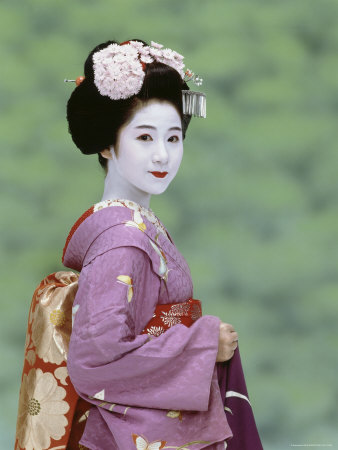
The Pleasure of Her Charms: Memoirs of a Geisha Review

MEMOIRS OF A GEISHA by Arthur Golden

Here again is another novel for which I had seen the film before reading the book.  I enjoyed the film adaptation of Memoirs of A Geisha as a beautiful and lavish visual feast.  Now that I've read the book, I can see why fans of the novel weren't too pleased with its adaptation.  I never worry about changes from book to screen: that is par for the course. 

Besides, I am not here to discuss the film's fidelity to the source material.  I am here to discuss the book itself.  I found Memoirs of a Geisha to have captured what a geisha speaking to you might sound like in its turns of phrases, but like all good geisha, kept much hidden from the reader.

The 'memoirs' are the first-person recollections of Sayuri, a retired geisha now living in New York City.  She tells the interviewer (and us) about her life, one that has been governed more by chance and fortune than any deliberate decision by Sayuri herself.  Her tale takes us from pre-to-post war Japan, taking place mostly before Japan's defeat in World War II though the last few chapters deal with some of the difficulties the post-war era had on both her and the world of geisha.   

She started out as Chiyo, the daughter of a poor fisherman in a little Japanese village.  Her home, which she calls 'the tipsy house' is far from the main village.  Her mother is dying, and after she is gone there will be only her father and her sister Satsu.  One day, which she describes as her best and worst day, she falls on the street, but this attracts the attention of wealthy businessman Mr. Tanaka.  Soon, Tanaka shows interest in both Chiyo and Satsu, in particular Chiyo with her marvelous blue-grey eyes. 

At first Chiyo believes Tanaka will adopt them and, to coin a phrase, take them away from all this.  Therefore, it comes as a shock and horror to discover that, far from adopting them, Tanaka has sold them, and they are whisked off to Kyoto, specifically the pleasure district of Gion.  She is now the property of an okiya (a home for geisha), while her sister is not.  The okiya is run by Mother, a particularly ugly woman in every way possible, and Granny, simply cantankerous.  Only Auntie shows Chiyo anything close to kindness.

The okiyo is home to Hatsumomo, a great geisha renowned for her beauty but who is at heart a monstrous and drunken bully.  She belittles and abuses everyone, including and especially both Chiyo and another girl whom Chiyo nicknames Pumpkin, a name that sticks even when Pumpkin begins to train as geisha herself.  Chiyo is terribly unhappy and wishes to be with Satsu, who has been sold to a whorehouse.  They manage to see each other and Satsu plans to run away, but on a dark and stormy night she falls from the roof in a failed escape.  Now Chiyo's own training to be geisha stops and she is basically a slave.

In the midst of all this misery, she has a fateful encounter while crying near a river.  A man comforts her, gives her some money and a handkerchief to dry her eyes.  This is The Chairman, who now inspires Chiyo to somehow become a geisha in the chance of reuniting with him.  Her prayers are answered in the form of Mameha, a famous and renowned geisha who is one of the few who can rival Hatsumomo in popularity.  Mameha strikes a bargain with greedy Mother: Mameha will take on Chiyo's training in the art of geisha, and if Chiyo fails to earn a certain amount in a certain time Mameha will pay Mother, but if she does then Chiyo's debts to the okiya are paid. 

Chiyo is at first frightened, given that Hatsumomo once forced Chiyo to deliberately ruin a beautiful kimono owned by Mameha, but soon she finds her 'older sister' to be a wise counselor and formidable trainer in the art of entertaining men.  Soon Chiyo becomes Sayuri, maiko (or apprentice) to Mameha and is becoming not only successful but a competitor to Hatsumomo, who is Pumpkin's older sister.  The ultimate success comes when Sayuri's virginity is auctioned off to a Dr. Crab (a nickname Sayuri has given him). 

Hatsumomo becomes more erratic and careless, and her behavior becomes too much even for Gion.  She is driven out after physically attacking a renowned kabuki actor, and Sayuri can now pursue Mameha's great plan: to get Sayuri a danna, or patron.  Mameha has selected Nobu, a partner in an electronic firm whose partner is The Chairman himself.  Sayuri does as she is told, and while she grows fond of Nobu, a most irascible man made more unattractive due to his war-time injuries which has left him one-armed and disfigured, Sayuri's heart remains with the Chairman.

Eventually, the Second World War brings this floating world to an abrupt end.  Sayuri has managed to get a general to be her danna, which has secured her okiya rationed supplies for a long time.  However, the general falls and only Nobu, still unhappy at Sayuri's choice of danna, is able to send her to the countryside to safety.  After the war, Sayuri still finds things difficult with a version of Gion reopening.  She manages to return to the world of geisha, but her plan to disillusion Nobu by 'accidentally' being discovered with another man goes awry when it's the Chairman who comes upon her.  Pumpkin, bitter about Sayuri's success and adoption to inherit the okiya, cause her to betray Sayuri. 

However, not all is lost.  The Chairman reveals himself to have been Mameha's sponsor for Chiyo, but was reluctant to become Sayuri's danna when Nobu began to show interest.  However, the Chairman reveals Sayuri's 'indiscretion' to Nobu, thus freeing the Chairman to take Sayuri as his mistress.  This arrangement forces Sayuri to retire as a geisha, and she eventually emigrates to the United States, with the Chairman still her patron.  The Chairman dies and leaves Sayuri to contemplate her extraordinary life.

Golden captures a voice of how one imagines a geisha would speak.  Many turns of phrases in Memoirs of a Geisha have a remarkably poetic air to them, and somehow I picture a woman trained to speak in somewhat elaborate manners.  If anything the voice of Sayuri is that of a properly demure woman.  She never sounds harsh or angry at how things have turned out or in remembering the cruel acts of Hatsumomo or Tanaka, or even her father for basically selling her out.

Instead, Sayuri seems to have a more resigned voice, one that accepts things as they came.  Minus her wish to become geisha so as to be reunited with the Chairman she never consciously takes any firm steps.  All her goals and dreams and aspirations are with that one singular hope: to be with the Chairman once again.

One does wonder why, whenever reflecting on just how cruel her abuse was at the okiya, there was never even a quick flash of anger.  One does wonder why, when reflecting on the loss of her family, there was never even a tinge of regret.  Instead, Sayuri speaks of all these things, and all things really, with the same voice: that of a woman trained to conceal her emotions and present only a smiling face to all whom she entertains. 

In fact, this isn't a fault in Memoirs of a Geisha in that if one believes that Sayuri is dictating her life story to a Westerner, she has opted to conceal more than she reveals.   Near the end of the book, she hints that she and the Chairman had a child, but never actually comes out and says, "I had a son with the Chairman".  Instead, like a good geisha, she subtly suggests this, but only once and almost in passing.

What Memoirs of a Geisha is really more about is the world of geisha, this lost "Floating World", and given Golden's various interviews one can trust the imagery of this world he paints.  Memoirs of a Geisha gives the reader a rare 'inside look' at this world which to outsiders, particularly Westerners, is all but forbidden. 

Memoirs of a Geisha, unfortunately, has as its protagonist who is more like a leaf caught in the currents of a river, sometimes tumultuous, sometimes placid, than of a fish trying to reach its spawning area.  Again, Sayuri never acts to better herself, but to continuously keep within reach of the Chairman, to be with the Chairman.  She has no goal save but the Chairman.  Few leads have been so wrapped up in keeping to her childhood dreams than Chiyo/Sayuri.  Sayuri never years for freedom of any kind: financial, emotional, spiritual. 

She tells us in her demure voice that she had, to her great surprise, once been ranked among the Top Twenty Gion Geisha of All Time.  She does not know how given she never saw herself as particularly good or beautiful or talented.  Yet one wonders if she was as good as they say she was (and as she suggests she was) why not have a plan or ambition to strike out on her own, become not just one of the great geisha but become her own woman?

Sayuri never does so. Instead, all her actions are geared to be with the Chairman in some way.  Whatever made her successful, whether it was her grace or conversational skills or dancing or what-have-you, we basically have to take it on faith.  Sayuri in a sense gives us a shadow of a geisha, which might be correct in how a geisha would behave to outsiders but doesn't give us much insight into herself as a person (apart from her quest to be with the Chairman).  In many ways, Sayuri is a mystery, and whether it is accurate for a geisha to keep hidden within her own memoirs is up to the reader.  I thought it sounded accurate to keep much emotion within herself.

What I found with Memoirs of a Geisha is that in many ways, it is like how I imagine spending time with an actual geisha would be.  First, I expect there would be no sex: geisha are not prostitutes.  In fact, they are the ones who will select their danna, and they are not going to have sex with every man they entertain.  Instead, geisha would entertain with words, dance, song, a bit of flirting, but nothing more. Memoirs of a Geisha does so: it entertains, but one doesn't race to read what is going to happen next.

I did not get what I call the Byzantium Effect with Memoirs of a Geisha.  In Stephen Lawhead's novel, I was left with such a cliffhanger that I charged ahead when reading, even if I was exhausted and only that would force me to stop.  In Memoirs of a Geisha, I found something entertaining, giving me a glimpse into a world I might never encounter personally, but not one I would rush to keep in.  Like a true geisha, Memoirs of a Geisha tells an interesting story, but once we bid good night, and is off to another engagement, the geisha leaves a pleasant memory but nothing personal behind.       

Arthur Golden
Born 1956
 

DECISION: B


Wednesday, November 14, 2012

There's No Cure For This Scarlet Fever: A Study in Scarlet Review


A STUDY IN SCARLET

A Study in Scarlet is the very first Sherlock Holmes story, one that I encountered when I was in middle school.  With the revival of Sherlock Holmes (via bad Guy Ritchie movies and two television programs: the BBC's Sherlock and CBS' Elementary) and as primer to reviewing the Sherlock adaptation (A Study in Pink) I decided to revisit my favorite detective.  My love for the great detective does not waver, and A Study in Scarlet, while more a novella than a full-fledged novel, is a great introduction to characters that will become iconic.  However, it's clear that a reading of A Study in Scarlet also reveals that Sir Arthur Conan Doyle is also writing in the traditional Victorian style, with all the melodrama and idealization of the Innocent Girl that comes with it.

The book is divided into two parts: Being a Reprint from the Reminiscences of John H. Watson, M.D., Late of the Army Medical Department, and The Country of the Saints.

John Watson, M.D., late of the Afghan Campaign, has returned to London to recover from his war wounds.    An old friend guides him to Sherlock Holmes, a man of great intelligence but who also, to Watson's horror, was unaware that the Earth revolves around the Sun.  Holmes justifies this by saying that such information is useless to him and his work, so should he learn such things, he will quickly dismiss them if they serve no purpose.  Why clutter his attic with junk, he argues, and since he sees his mind as an attic, such things as the Earth's rotation is unimportant.

Holmes, Watson discovers, is what the former calls a 'consulting detective'.  People, including the police, come to him to help them out in solving mysteries, all the hush-hush, for which he is paid handsomely.  He does it more for the pleasure of the work than for the actual money.  Now, he gets a corker of a case: a murder.

His police contact Inspector Gregson has brought him to help solve this particular crime: the murder of Enoch Drebber, American.  There is no mark on the body, but the word "rache" in blood on the wall.  Holmes, with his magnifying glass, does his work, while Gregson and his colleague Inspector Lestrange sort out their theories, which we find are wrong. 

Now Holmes and Watson set a trap for the killer, but the killer tricks Holmes by doing a drag act.  Holmes, now infuriated by being fooled and determined to find him, continues on the case.  A few days later, Gregson arrests someone but that theory goes out when we find that Drebber's travelling companion, Joseph Stangerson, has been found murdered.  However, Holmes has already discovered the murderer's identity, and with the help of street urchins Holmes has dubbed "the Baker Street Irregulars", our murderer, Jefferson Hope, an American who works as a cabbie, is arrested.

It's here that we get Part II.  Out in the American West, Joseph Ferrier and a little girl named Lucy are the only survivors of a pioneer group.  They face certain death in the desert, until they are miraculously discovered by the Mormon pioneers.  Brought before Brigham Young himself, the Prophet agrees to bring them into their group on the condition that Joseph and Lucy adopt the Latter-Day Saints faith.  They readily agree, and in Utah the Ferriers (as Joseph had adopted Lucy) prosper. 

However, the pressure for Joseph to have plural marriages grows.  He resists, but he knows that his Lucy, that Flower of Deseret, runs the risk of being forced into this immoral union to a Mormon.  Complicating matters is that Lucy, that Flower of Deseret, has herself fallen in love...with Jefferson Hope, non-Mormon.  Brigham Young himself comes to inform Joseph that he must surrender Lucy, that Flower of Deseret, to one of two suitors: Joseph Stangerson or Enoch Drebber.  He has 30 days.  Each day Ferrier finds a written number somewhere, counting down the days.  Finally, close to the end date, Hope literally arrives.

They flee into the mountains, aiming for Nevada, but while Hope is away searching for food the others are overtaken.  Lucy, that Flower of Deseret, is forced to marry Drebber, while Stangerson we find had killed Joseph when they were captured.  Lucy, that Flower of Deseret, dies of a broken heart, and Hope swears revenge. 

Now we get back to the present, but while Hope is captured, his heart condition allows him to escape prison, even though he really had done the right thing in avenging Joseph Ferrier and Lucy, that Flower of Deseret.  Holmes finds that Gregson and Lestrange received credit for solving the crime, while Holmes gets barely a notice.  For his part, Holmes doesn't care, but Watson determines to credit his roommate for solving this most curious case.

It's curious that Conan Doyle, early in A Study in Scarlet, has Holmes show contempt for his contemporary 'fictional' detectives such as Poe's Dupin or Emile Gaboriau's Monsieur Ledoq.  I can't say that it reflects Doyle's own views on the detective mysteries that had come before, but it does add two things to our understanding of author and creation.  One, it shows that the character of Holmes takes his position very seriously, and two, it shows Conan Doyle was fully aware that he was drawing from a newly-discovered well.  It also is a mark of the giant shadow Sherlock Holmes casts in that with the exception of Poe almost all detective writers pre-Doyle are now largely forgotten.

When was the last time Monsieur Ledoq appeared on the screen?  Gaboriau and Ledoq are all but forgotten today, while Doyle and Holmes are now seen as the standard to which all detectives post-Study in Scarlet are measured.  Hercule Poirot, Nero Wolfe, Ellery Queen, right down to The Mentalist's Patrick Jane and even Encyclopedia Brown all are descendants of Sherlock Holmes (in regards to Wolfe, perhaps more direct than perhaps we imagine).

A Study in Scarlet has all those twists and turns a good detective story has: the surprise of finding an old woman rather than a youngish man coming to collect the ring, the strange clue of 'rache' in blood written upon the wall.  More than that, though, A Study in Scarlet set up the importance of science and analytical thought to solving a case.

Dr. Doyle would have some background in this.  All doctors have to play detective to a point.  You have to analyze the symptoms in order to come up with a diagnosis.  Doyle was perhaps the first detective writer to understand that one can't just guess or have a clue or witness just miraculously pop up to discover the criminal.  Instead, he (or she) has to observe everything to find whodunit.

Look at when Holmes goes to the crime scene.  Watson is amazed that Holmes doesn't charge into the room where the body is; instead, he looks outside, studying the wheel marks and footprints left in the mud.  Holmes does what other detectives did not: he looked, he studies, he observed.  From that, he drew conclusions which invariably proved right.  "It is a capital mistake to theorize before you have all the evidence," Holmes tells the good Doctor.

Sadly, today that bit of streets-smart is all but forgotten.  In particular the press is quick to find motives and criminals without all the evidence.  Instead, we start speculating to where we make the facts fit the theories rather than the theories fit the facts.  Doyle understood that we need to look at what is presented before us before we can say for certain what the truth is.

Sadly, what he didn't understand was Mormonism.  I'm not a Mormon, but the portrayal of the Latter-Day Saints as this group of virtually sex-crazed murderers both dates and stains A Study in Scarlet.  It's a curious thing that if Conan Doyle had made the religious group that threatens this innocent pair with forced marriages wild-eyed pursuits Muslims, it's pretty easy to imagine that A Study in Scarlet would probably be banned and/or go out of print.  Because the group he portrays so badly is the Mormons, Doyle could get away with it and we don't think too much on that, given that the popular concept of Mormons now is that of non-threatening young men and women coming to our door with ties or skirts.  I imagine Doyle would be surprised to see that these neo-savages he had written are now seen as some of the most docile members of society. 

The negative images of Mormons is a mark against A Study in Scarlet, but what really shows when the book was written is in the character of Lucy.  While rereading A Study in Scarlet, I couldn't help think on what Oscar Wilde said about a character from The Old Curiosity Shop: "One must have a heart of stone to read the death of Little Nell without laughing".  Dickens' novel was published a good forty-seven years prior, but Lucy Ferrier might as well have been named Little Nell.  Both girls are portrayed as sweet darlings, angels of purity really, who suffer greatly and die tragically.

This is I imagine part of what makes Victorian writing a bit overwrought: the creation of female characters as delicate flowers who wilt away at the cruelties of life.  I kept referring to Lucy as That Flower of Deseret because she was so delicate, so sweet, so pure, that at times she was not real.  Instead, she was just an idealization of innocent young womanhood, smeared by the evil Mormons.

In this this, I won't fault Doyle too much.  He was writing as a Victorian author, and as such was versed in the style of the times.  He wasn't going for some epoch-changing work of literature, he was going for a good detective story that would earn him some money while contributing what I imagine he thought was superior work in the growing detective genre.  A Study in Scarlet did do that, and it introduced the now-iconic magnifying glass and the scientific method of investigation to the genre. 

All detectives following Sherlock Holmes owe their existence to the resident of 221 B Baker Street (which I have visited and spent many a happy hour at).  It suffers today from two flaws: a negative portrayal of a religious group that in others would be condemned as bigotry and a rather cliched Victorian female character (Lucy is no Irene Adler, that's for sure).  Minus those bits, A Study in Scarlet is a good introduction to those not familiar with the Sherlock Holmes mythos, a strong mystery with a logical conclusion.  It is a Victorian work, but it is one that has stood the test of time.

The pleasure one gets from A Study in Scarlet is more than elementary.           

     
Sir Arthur Conan Doyle
1859-1930


DECISION: A